Rebar Threading Machine in India: How It Works, Price, Benefits and How to Choose the Right One
By Surya Engineering, Mumbai — manufacturer of rebar threading machines and rebar couplers for projects across India.
Let me take you to a site I have seen many times.
It is the 14th floor of a tower coming up outside Mumbai. The column bars are up, the next lift is waiting, and the joint — the place where one bar ends and the next begins — is a mess. Bars lapped over each other, tied with binding wire, so crowded that the vibrator can barely get in. The engineer knows the concrete will struggle to flow. The contractor knows how much steel is buried in that overlap, doing nothing except overlapping. Now picture the same joint with a coupler. Two bar ends, each with a clean thread cut or rolled on a rebar threading machine, screwed into a steel sleeve in under a minute. No overlap. No crowd. The joint is as strong as the bar itself. That difference — between lapping and threading — is why almost every large project in India today, from metro lines to expressways, has quietly moved to mechanical splicing. And at the centre of that move sits one unglamorous, hard-working machine.
What is a rebar threading machine, in plain words?
A rebar threading machine puts a screw thread on the end of a reinforcement bar — the same TMT bar you call “sariya” on site — so it can be joined end-to-end with a threaded rebar coupler. That is it. No mystery. The machine grips the bar, peels or cuts away the ribs at the tip (or cold-forges the end larger first, depending on the system), and forms a precise parallel or taper thread. Screw on the coupler, bring the next threaded bar, tighten — and you have a continuous line of steel. Think of it like this: lapping is tying two ropes together with a long, bulky knot. Threading is fitting both ropes with a proper connector. One looks makeshift. The other looks engineered — because it is.
How Does a Rebar Threading Machine Work?
The process is straightforward when the correct machine, tooling and coupler system are used.
Step-by-Step Rebar Threading Process
1. Cut the Bar Square
Start by cutting the TMT bar to the required length. The bar end should be clean and square. An uneven cut can result in an uneven thread.
2. Prepare the Bar End
Depending on the coupler system, the bar end may require rib peeling or cold forging (upsetting) before threading.
3. Set the Machine
Install the correct dies, chasers or rollers according to the bar diameter. Set the required thread length and pitch according to the coupler specifications.
4. Perform Threading
Secure the reinforcement bar in the machine. The threading head then cuts or rolls the required thread onto the prepared bar end.
5. Check the Thread
Inspect the finished thread for correct length, finish and dimensions. Use the appropriate thread gauge to verify the threading quality.
6. Protect the Thread
Fit a protective plastic cap over the finished thread to protect it from dust, rust, mud and transportation damage.
7. Connect the Coupler
Install the compatible rebar coupler and connect the next threaded reinforcement bar. Tighten the connection according to the approved installation procedure.
This process should follow the applicable project specifications and quality requirements, including IS 16172:2023 where applicable.
Cut Thread, Roll Thread or Taper Thread – What Is the Difference?
Different threading systems are used depending on the reinforcement bar, coupler design and project requirements.
| Feature | Roll Thread (Parallel) | Cut / Chaser Thread | Taper Thread |
|---|---|---|---|
| Thread formation | Rollers form the thread by pressing | Blades or chasers cut the thread | Thread is formed with a taper |
| Steel removal | No steel removed during rolling | Steel is removed during cutting | Depends on cutting process |
| Application | Mechanical splicing systems | Suitable compatible coupler systems | Projects specifying taper threading |
| Tooling | Thread rollers | Dies or chasers | Taper threading tooling |
| Inspection | Appropriate gauge and visual checks | Appropriate gauge and visual checks | Gauge and specified tightening checks |
Our advice: Do not select a threading machine only by its thread type. Choose a complete system consisting of the machine, compatible tooling and matching rebar coupler.
Why Are Indian Construction Projects Using Rebar Couplers Instead of Lap Splices?
Traditional lap splicing has been used in reinforcement work for many years. However, as construction projects become taller and reinforcement diameters increase, mechanical splicing offers several practical advantages.
| Feature | Lap Splice | Threaded Coupler |
|---|---|---|
| Steel consumption | Requires additional overlapping steel | Eliminates the overlapping length at the joint |
| Connection | Depends on reinforcement development and surrounding concrete | Transfers load through a mechanical connection |
| Reinforcement congestion | Creates overlapping bars | Uses a compact connecting sleeve |
| Installation | Requires overlapping and binding | Requires compatible threaded bars and coupler |
| Quality control | Depends on placement and site workmanship | Allows inspection of the threaded connection |
Industry experience consistently puts steel saving from couplers in the region of 3–5% of reinforcement steel on a typical project — and much more on heavy columns with 32 mm and 40 mm bars. On a project using thousands of tonnes, do that calculation once and the machine pays for itself in your head.
Where Are Rebar Threading Machines Used in India?
1. Metro Rail and Railway Projects
Used in station structures, tunnels, viaducts and other reinforcement-intensive construction work.
2. Highways, Bridges and Flyovers
Useful for reinforcement connections in bridge piers, pile cages and large infrastructure structures.
3. High-Rise Buildings
Suitable for residential and commercial towers where reinforcement congestion and construction speed are important considerations.
4. Precast, Dams, Ports and Industrial Projects
Used in precast yards, power plants, industrial structures and other projects where reinforcement bars are prepared in larger quantities.
For small residential construction and low reinforcement quantities, conventional lap splicing may still be suitable where permitted by the structural design.
Rebar Threading Machine Manufacturer in India – Surya Engineering
Surya Engineering is a Mumbai-based manufacturer of rebar threading machines and rebar couplers, supplying equipment and reinforcement connection solutions for construction and infrastructure projects across Pan-india India.
Our manufacturing works are located at:
Works Address: R-6, Raju Nagar, Chandivali, Sakinaka, Mumbai – 400072.
Office Address: Shop No. 3, Sandstone Building, Kanakiya Road, Mira Road, Thane – 401107.
We manufacture threading machines and compatible couplers, helping customers select the appropriate equipment for their reinforcement requirements.
Our support includes:
- Machine selection and configuration guidance.
- Installation and machine setup guidance.
- Operator training.
- Threading and coupler compatibility assistance.
- Technical guidance for reinforcement preparation.
Our Rebar Roll Threading Machine Models
Surya Engineering offers two roll threading models for reinforcement bar threading applications.
| Specification | CDRG-45 | SE-50 |
|---|---|---|
| Bar Diameter | 16–40 mm | 16–40 mm |
| Motor | 5 HP | 7.5 HP |
| Speed | 40–62 RPM | 62–80 RPM |
| Thread Pitch | 2.5 / 3.0 mm | 2.5 / 3.0 mm |
| Threading Length | 100 mm | 120 mm |
| Weight | 380 kg | 450 kg |
Our wider rebar threading machine range covers 12–40 mm reinforcement bars, with parallel or taper threading configurations, IS / BS pitch options, thread lengths of 25–80 mm and single-phase or three-phase electrical supply options.
Motor configurations range from 1.5 kW to 7.5 kW.
We also manufacture BTS / BST chaser machines for coupler manufacturing and hydraulic cold forging machines for reinforcement systems that require upset ends.
Which Rebar Threading Machine Should You Choose?
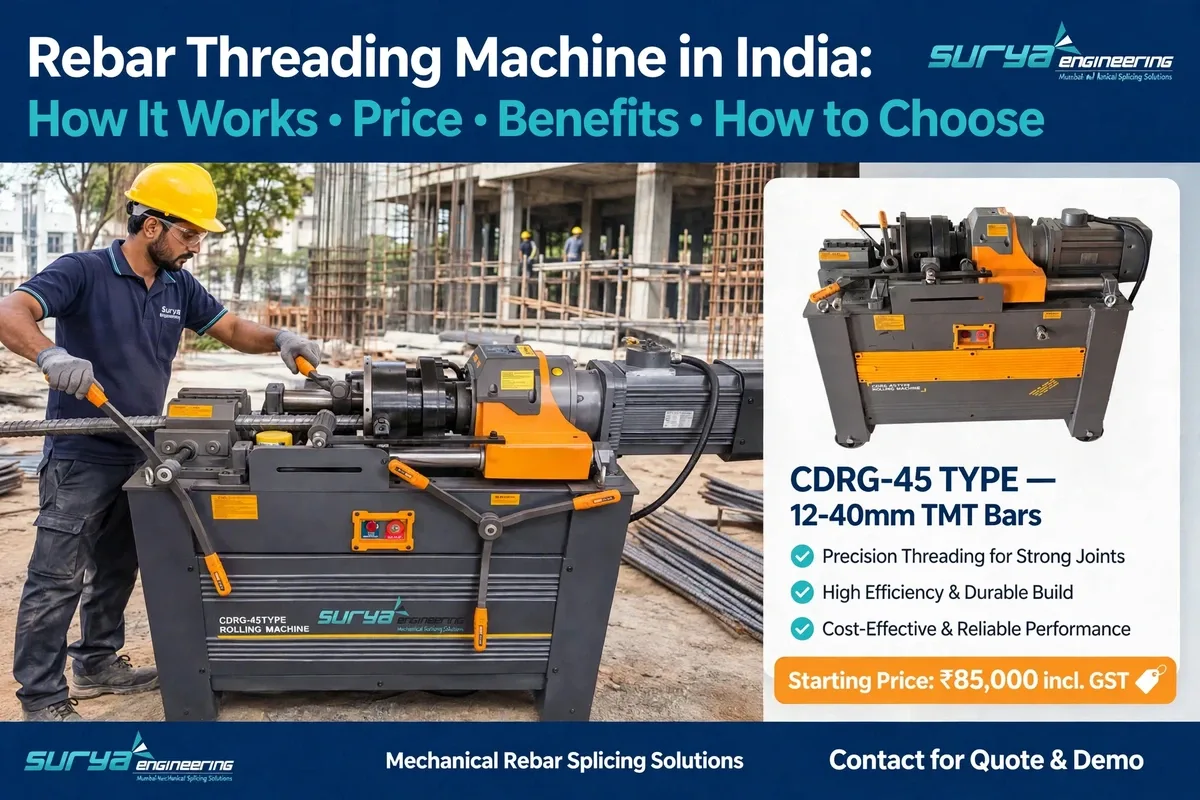
CDRG-45 Rebar Threading Machine
The CDRG-45 is suitable for regular threading work in construction yards and fabrication facilities. It handles 16–40 mm bars and comes with a 5 HP motor.
SE-50 Rebar Threading Machine
The SE-50 offers a 7.5 HP motor, higher operating speed and a longer threading length. It is suitable for buyers handling regular, higher-volume threading requirements.
The correct model depends on your bar diameter, daily production target, thread specifications and available electrical supply.
Choose Your Rebar Threading Machine: Surya's Models Compared
Surya Engineering offers different rebar threading machine configurations for different applications.
| Machine Model | Price (Including GST) | Main Specifications |
|---|---|---|
| Rebar Threading Machine | From ₹85,000 | 12–40 mm, parallel or taper thread, 1.5–7.5 kW |
| TMT Rebar Threading Machine | ₹90,000 | 12–40 mm bar range |
| CDRG-45 Rebar Threading Machine | ₹95,000 | 16–40 mm, 5 HP, 100 mm threading length |
| Rebar Roll Threading Machine (CDRG-45 / SE-50) | ₹1,00,000 | 16–40 mm, up to 7.5 HP, 120 mm threading length |
Prices are based on the product listings referenced in the November 2026 edition. Confirm the latest price and configuration before ordering.
Match the Machine to Your Requirements
For Site Contractors
The CDRG-45 is a practical option for regular threading requirements involving 16–40 mm reinforcement bars.
For Coupler Manufacturers
Consider higher-capacity roll threading equipment and ask about BTS / BST chaser machines for coupler production.
For Small Builders
A suitable lower-power configuration with single-phase supply may be more practical than purchasing an oversized machine.
For Forged-End Coupler Systems
A rebar threading machine can be paired with a cold forging machine, depending on the coupler design and bar diameter.
Surya Engineering offers SE-32 cold forging machines for 16–32 mm bars and SE-40 machines for 16–40 mm bars.
Running a Rebar Threading Machine: Operation and Maintenance
A rebar threading machine needs correct operation and regular maintenance to produce consistent threads.
The Threading Cycle
1. Cut Square: Cut the reinforcement bar end cleanly and squarely.
2. Prepare the End: Remove ribs where required or use a cold forging machine to enlarge the bar end for forged-end threading systems.
3. Thread the Bar: Secure the bar, select the correct tooling and perform the cutting or rolling operation. Maintain the recommended lubrication throughout the process.
4. Gauge-Check: Inspect the finished thread with the appropriate thread gauge. Check the first bars of each shift and after every bar-size change.
5. Cap and Stack: Protect finished threads with plastic caps and store threaded bars carefully to prevent damage.
Rebar Threading Machine Maintenance
Daily Maintenance
- Clean dies and rollers.
- Maintain the required cutting or rolling lubricant level.
- Remove metal chips and debris from the machine bed.
- Check the machine working area.
Every Shift
- Check the first threaded bars with the appropriate gauge.
- Inspect the thread after every size change.
- Maintain a record of tooling usage.
Weekly Maintenance
- Check clamps, guides and fasteners.
- Inspect dies, chasers and rollers for wear.
- Check machine alignment and moving components.
Tooling Replacement
Replace worn tooling when inspection indicates that it is no longer producing acceptable threads. Regular tooling inspection helps reduce rejected bars and unnecessary machine downtime.
Common Rebar Threading Problems and Solutions
| Problem | Possible Cause | Recommended Action |
|---|---|---|
| Coupler does not screw onto the bar | Incorrect thread pitch or thread type | Check the machine setting and coupler drawing |
| Loose or sloppy threads | Worn rollers, dies or chasers | Inspect tooling and replace if required |
| Rough or damaged thread finish | Dirty tooling or insufficient lubrication | Clean tooling and restore lubricant flow |
| Thread quality changes during operation | Tooling wear | Inspect tooling and check usage records |
Rebar Couplers: Sizes and Types Supplied by Surya Engineering
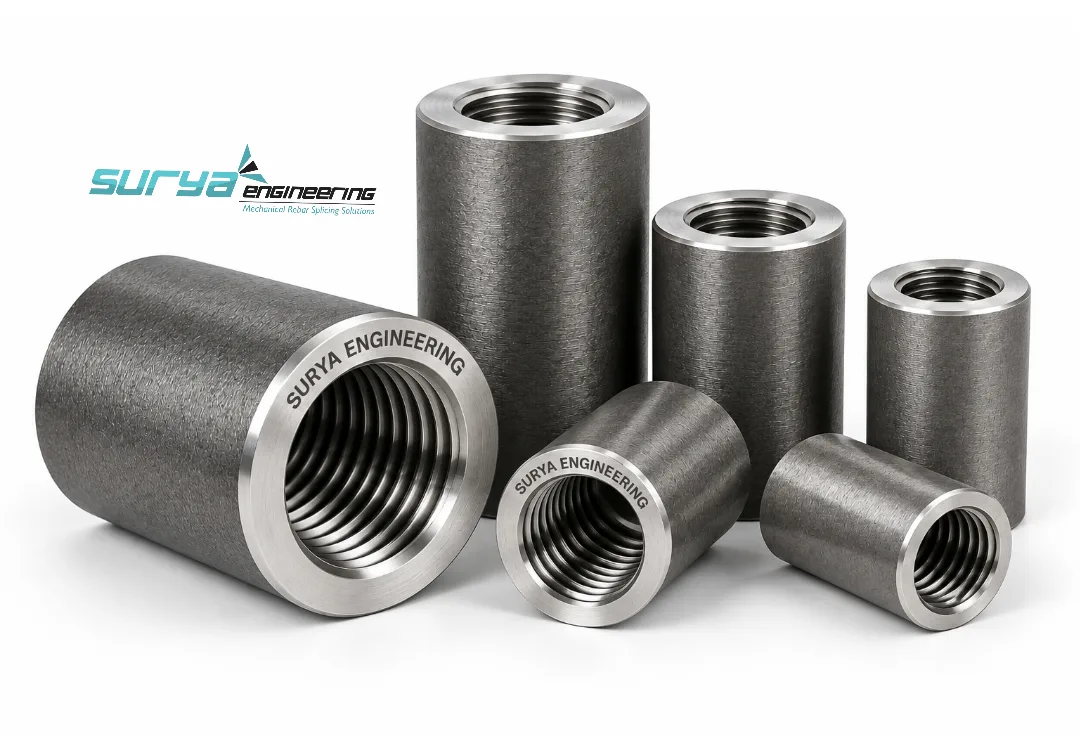
The threading machine prepares the bar end, while the rebar coupler connects two reinforcement bars.
Choosing the correct coupler is essential for achieving the required mechanical connection.
Available Rebar Coupler Sizes
Surya Engineering manufactures rebar couplers from 12 mm to 40 mm.
| Bar Diameter | Common Applications |
|---|---|
| 12 mm | Small residential and building projects |
| 16 mm | Residential and commercial construction |
| 20 mm | Building and infrastructure projects |
| 25 mm | High-rise and infrastructure construction |
| 32 mm | Heavy reinforcement applications |
| 40 mm | Large infrastructure and structural projects |
Custom coupler dimensions can also be discussed according to project requirements, drawings and technical specifications.
Types of Rebar Couplers
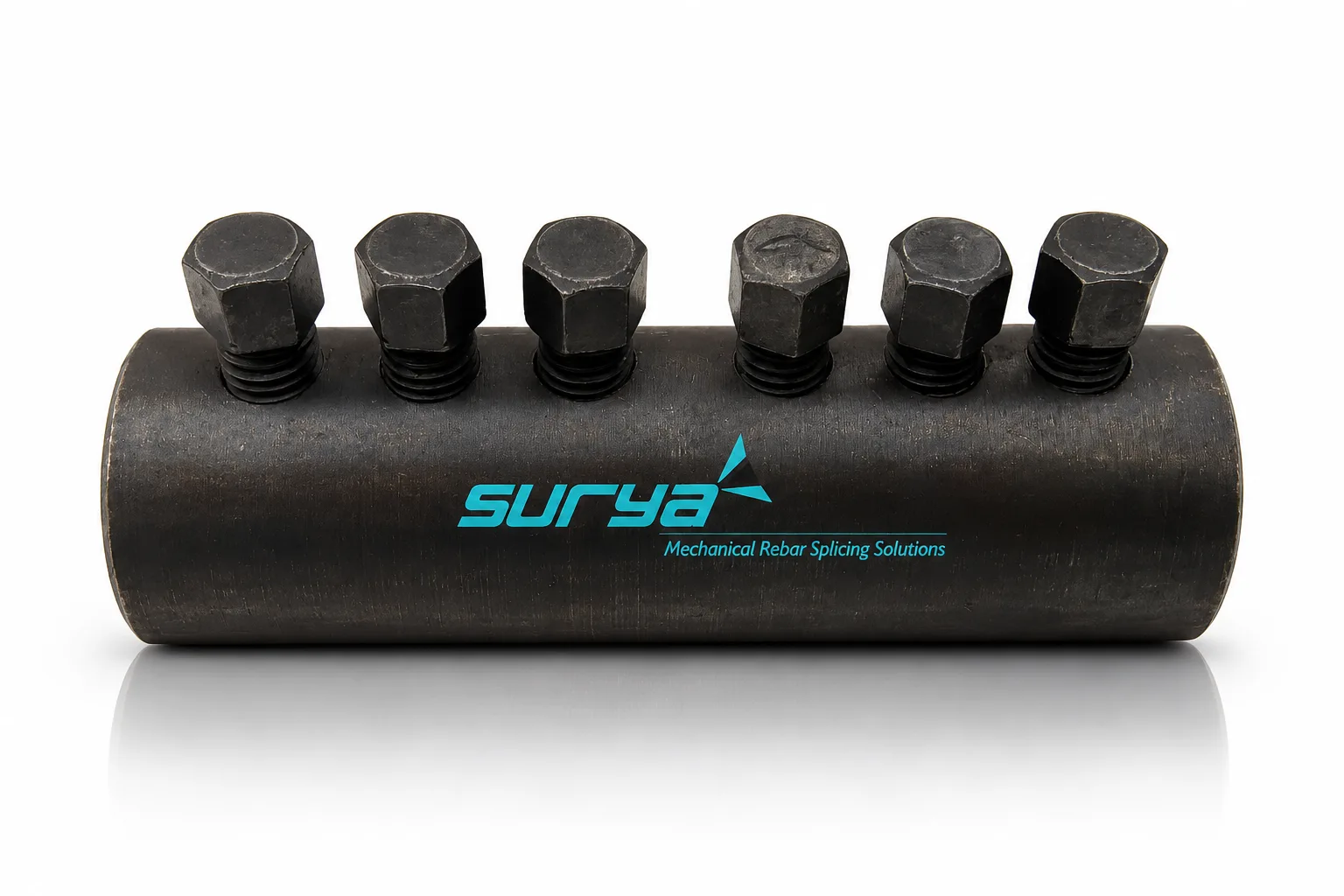
1. Cold Forged Rebar Coupler
Cold forged couplers use an upset or enlarged reinforcement bar end before threading. This system is suitable for projects requiring mechanical splicing with appropriately designed and tested components.
2. Parallel Threaded Coupler
Parallel threaded couplers use straight parallel threads on the reinforcement bar. They are used in compatible reinforcement connection systems.
3. Taper Threaded Coupler
Taper threaded couplers use tapered threads. The threading machine and coupler must have matching thread specifications.
4. Roll Threaded Coupler
Roll threaded couplers use threads formed through a rolling process. They are used in suitable reinforcement sizes and compatible mechanical splicing systems.
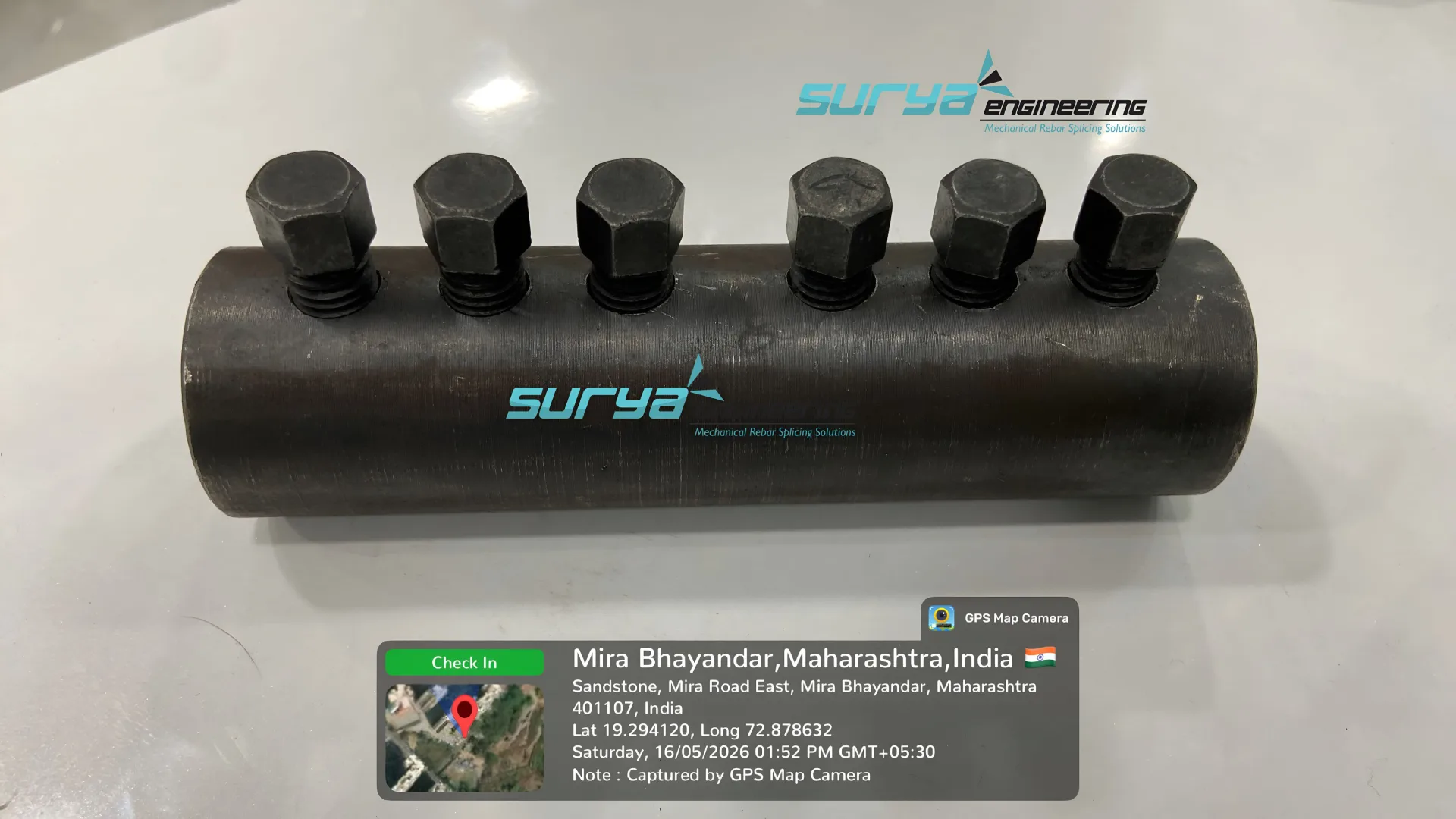
5. MBT Coupler
An MBT coupler is useful in situations where conventional threading is not practical, such as connecting an existing reinforcement bar that has already been cast into concrete.
6. One Touch Coupler
One Touch couplers provide a mechanical connection without conventional bar-end threading. They may be considered for specific reinforcement connection requirements.
How to Choose the Right Rebar Coupler
Rule 1: Consider the Reinforcement Bar Grade
The coupler material and design should be suitable for the reinforcement grade, such as Fe 500, Fe 500D or Fe 600, and the project's required mechanical performance.
Rule 2: Consider the Bar Diameter and Threading Method
The correct preparation method depends on the bar diameter, thread design and coupler system.
For larger reinforcement sizes, cold forging may be required to compensate for the reduced section associated with threading. The final selection must follow the approved coupler design and applicable testing requirements.
Rule 3: Match the Coupler to the Project
| Project Requirement | Possible Coupler Selection |
|---|---|
| Small residential building | Suitable small-diameter threaded or mechanical couplers |
| Mid-rise building | Compatible roll or parallel threaded couplers |
| High-rise construction | Approved threaded mechanical splicing systems |
| Infrastructure projects | Appropriately tested mechanical couplers |
| Existing bar with no available lap length | MBT or another approved non-threaded connection system |
Before ordering, provide the following information:
- Nominal reinforcement bar diameter.
- Reinforcement grade.
- Coupler internal diameter (ID).
- Coupler external diameter (OD).
- Required coupler length.
- Thread pitch and type.
- Project application and technical drawing.
Rebar Threading Machine Price in India – What Should You Expect?
One of the first questions buyers ask is: What is the price of a rebar threading machine in India?
At Surya Engineering, our listed rebar threading machine prices start from ₹85,000, including GST.
Rebar Threading Machine Price List
| Machine | Listed Price |
|---|---|
| Rebar Threading Machine | ₹85,000 onwards |
| TMT Rebar Threading Machine | ₹90,000 |
| CDRG-45 Rebar Threading Machine | ₹95,000 |
| Rebar Roll Threading Machine | ₹1,00,000 |
Prices are indicative of the referenced product listings and may change depending on configuration and availability.
Factors Affecting Rebar Threading Machine Price
The price of a rebar threading machine depends on several factors:
- Bar Diameter Range: Machines designed for larger reinforcement sizes may require different configurations.
- Motor Capacity: Motor power and electrical requirements influence the machine configuration.
- Threading System: Cutting, roll threading and taper threading systems use different tooling arrangements.
- Tooling Quality: The quality and availability of rollers, dies and chasers affect operating costs.
- Machine Construction: Frame design, weight and mechanical construction influence the overall machine price.
- After-Sales Support: Spare parts, technical guidance, installation and service support are important considerations.
7-Point Checklist Before Buying a Rebar Threading Machine
1. Check the Bar Diameter Range
Identify the smallest and largest reinforcement bar sizes you regularly use.
2. Match the Coupler Drawing
The thread type, pitch and length must match the selected coupler.
3. Check Electrical Requirements
Confirm whether your site has single-phase or three-phase electrical supply.
4. Calculate Daily Threading Requirements
Estimate how many reinforcement bar ends you need to thread daily.
5. Request a Sample Thread
Ask the manufacturer to thread sample bars and check coupler compatibility before purchasing.
6. Check Quality and Inspection Requirements
Confirm the applicable IS 16172:2023 requirements and the inspection process for your mechanical splicing system.
7. Confirm Spare Parts and Service
Check the availability of dies, rollers, chasers and technical support.
Frequently Asked Questions About Rebar Threading Machines
1. Which bar sizes can a rebar threading machine handle?
Surya Engineering's overall rebar threading machine range covers 12–40 mm reinforcement bars. The CDRG-45 and SE-50 roll threading models cover 16–40 mm bars.
2. Can one machine work with any rebar coupler?
No. The threading machine must produce a thread compatible with the coupler's thread type, pitch and length. Always check the coupler drawing before selecting a machine.
3. Do I also need a cold forging machine?
A cold forging machine is required when the selected coupler system uses upset or forged reinforcement bar ends. Some compatible parallel roll-threading systems do not require forging.
4. Is a threaded coupler joint as strong as the reinforcement bar?
A properly designed, manufactured, installed and tested mechanical splice is intended to develop the required reinforcement strength. Its performance must be verified according to the applicable standard and project specifications.
5. How long does threading one bar end take?
On a properly configured machine, the threading operation itself can take under a minute for typical applications. Total production time also includes cutting, handling, checking and stacking.
6. Can a rebar threading machine thread Fe 500D, Fe 550D and Fe 600 bars?
Machine suitability depends on the reinforcement diameter, material properties, tooling and threading system. Confirm the bar grade and size with the manufacturer before ordering.
7. Does Surya Engineering supply rebar threading machines outside Mumbai?
Yes. Surya Engineering supplies machinery and supports customers across India. Share your project location to discuss delivery and technical support.
8. What information is required for an exact machine quotation?
Provide your reinforcement bar sizes, coupler type or drawing, required thread pitch, electrical supply and estimated daily threading requirement.
9. How many bar ends can a threading machine process per day?
There is no single production figure for every machine. Daily output depends on bar diameter, thread length, operator experience, material handling and machine configuration.
10. What maintenance does a rebar threading machine require?
Clean the dies and rollers regularly, maintain lubrication, inspect tooling, check the first threaded bars of every shift and protect finished threads with plastic caps.
Coupler FAQs – Additional Questions
11. Which rebar coupler sizes does Surya Engineering manufacture?
Surya Engineering manufactures rebar couplers from 12 mm to 40 mm. Standard sizes include 12, 16, 20, 25, 32 and 40 mm. Custom dimensions can be discussed according to project requirements.
12. When is cold forging required before threading?
Cold forging may be required for larger reinforcement bars, particularly 25 mm and 32 mm sizes, depending on the coupler design and required mechanical performance. The selection should follow the approved engineering design.
13. What is the difference between an MBT coupler and a One Touch coupler?
Both can connect reinforcement bars where conventional threading is not practical. They use different mechanical connection designs and performance characteristics. Selection should be based on project requirements and approved testing.
14. What details are needed to recommend the correct rebar coupler?
Provide the reinforcement diameter, bar grade, coupler ID, OD, length, thread pitch and project application. A technical drawing or site inspection can help determine the appropriate coupler.
Contact Surya Engineering for Rebar Threading Machines
Looking for a reliable rebar threading machine manufacturer in India?
Surya Engineering manufactures rebar threading machines, roll threading machines, TMT bar threading machines, rebar couplers and associated reinforcement equipment for construction and infrastructure applications.
Our team can help you select a machine according to your bar diameter, threading requirements, production target and project specifications.
Company: Surya Engineering, Mumbai
Call: +91 92234 46390
Email: surya.engineers2000@gmail.com
Office: Shop No. 3, Sandstone Building, Kanakiya Road, Mira Road, Thane – 401107, Maharashtra, India.
Contact our team today with your reinforcement bar sizes and coupler drawing. We can help you identify a suitable threading machine for your application.