
By Surya Engineering Technical Team, rebar coupler manufacturer in Sakinaka, Mumbai. Last updated: 21 October 2026.
Quick answer: Surya Engineering is a rebar coupler manufacturer in Sakinaka, Mumbai, supplying parallel threaded and MBT couplers across India. A rebar coupler is a steel sleeve that joins two reinforcement bars end to end, so the bars do not need to overlap. It saves steel, reduces congestion and speeds up work on site.
What is a rebar coupler?
A rebar coupler is a mechanical device that connects two TMT bars in a straight line. This is called mechanical splicing. The bar ends are threaded or prepared, and the coupler holds them together as one continuous bar.
Rebar couplers are used in buildings, bridges, metro structures, tunnels, dams and industrial plants. They are common where bars are heavy or the reinforcement is too congested to lap.
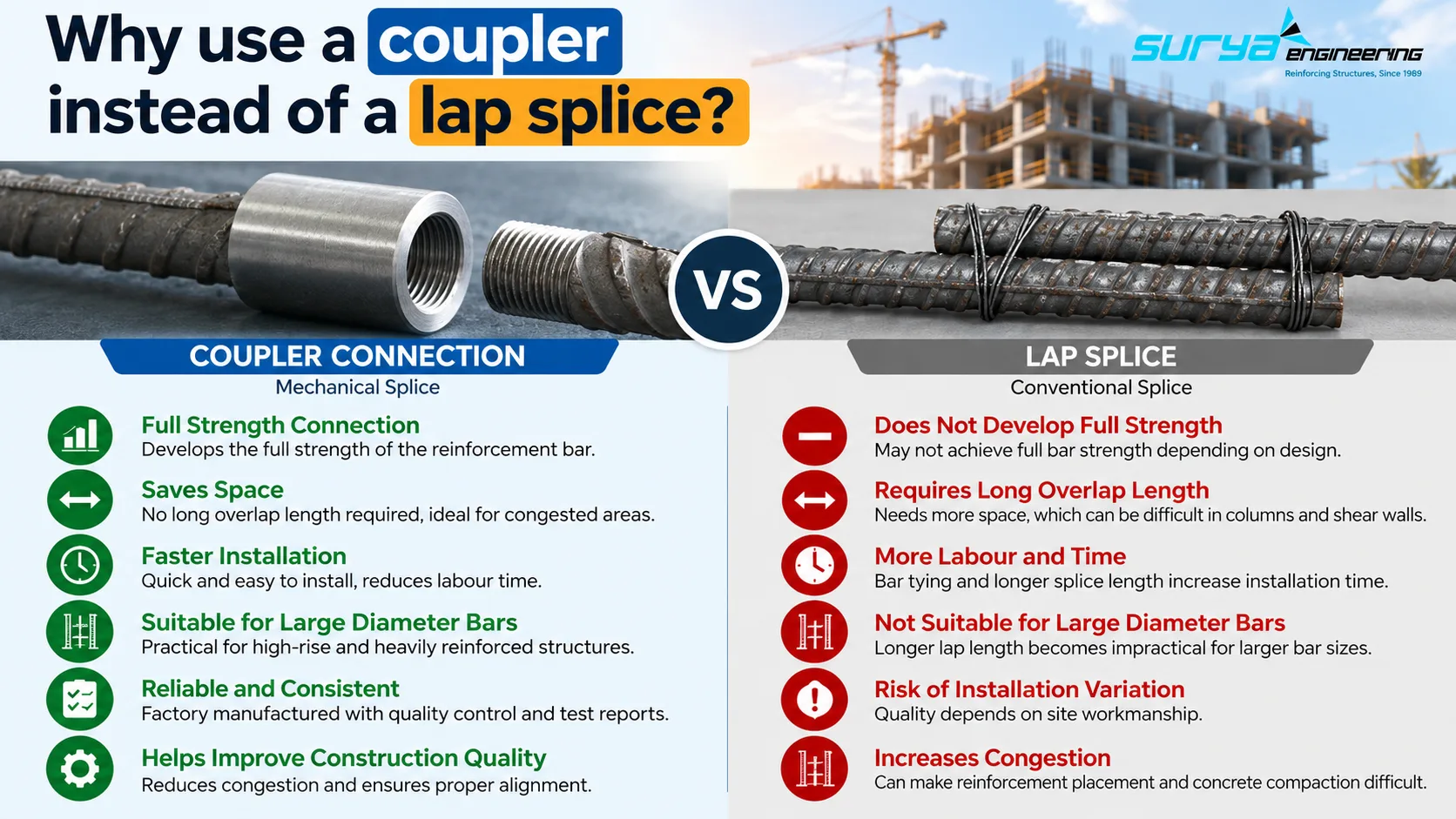
Why use a coupler instead of a lap splice?
In a lap splice, two bars overlap for a set length. The overlap wastes steel, and in dense columns and beams it makes concreting harder. Couplers help in four ways:
- Less steel wasted: no overlap length is needed.
- Less congestion: concrete flows around the bars more easily.
- Faster work: joining bars is quicker than tying long overlaps.
- Continuous load path: the joint carries the bar's load directly.
Rebar Couplers vs Traditional Lap Splicing
Rebar couplers and lap splices serve the purpose of connecting reinforcement, but they do so differently.
| Comparison point | Mechanical rebar coupler | Lap splice |
|---|---|---|
| Connection method | Mechanical connector between bars | Bars overlap for a specified length |
| Reinforcement congestion | Can reduce congestion at the connection | Overlapping bars increase local reinforcement volume |
| Steel quantity | Depends on coupler design and detailing | Depends on the required lap length |
| Installation | Requires compatible preparation and correct assembly | Requires correct overlap, positioning and detailing |
| Quality checks | Coupler compatibility, engagement and specified tests | Lap length, placement and reinforcement detailing |
| Suitability | Depends on the approved mechanical splice design | Depends on the structural design and applicable detailing rules |
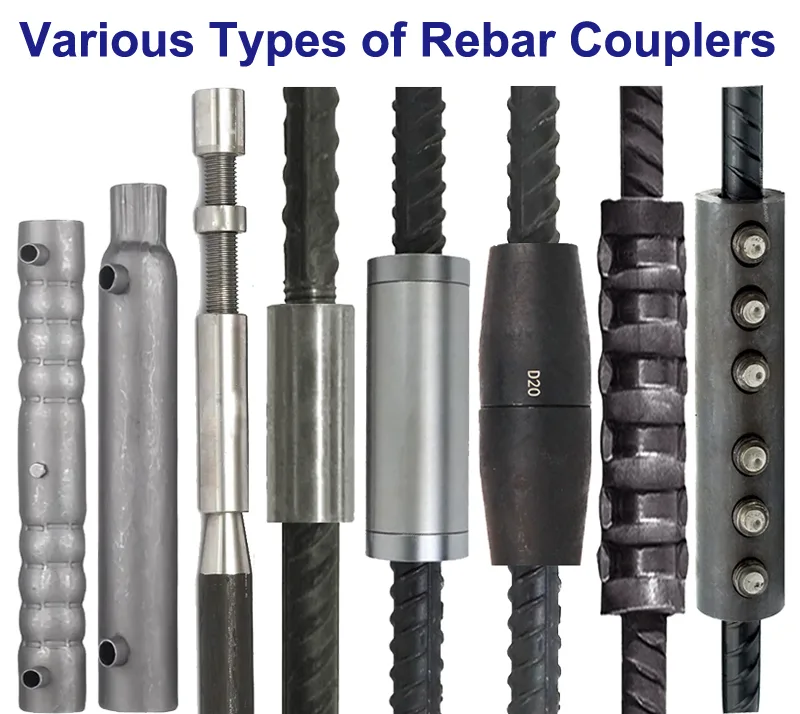
What are the types of rebar couplers?
| Type | How it works | Typical use |
|---|---|---|
| Parallel threaded | Both bar ends are threaded to the same pitch and the coupler screws onto them | Most building and infrastructure work |
| Taper threaded | Tapered threads on the bar and coupler | General construction |
| MBT (bolted) coupler | Bolts grip the bar ends inside a sleeve | Where threading is not possible |
| Transition coupler | Joins bars of different diameters | Changes in bar size |
| Position coupler | Joins bars that cannot be turned | Precast and fixed bars |
| Swaged (cold-pressed) | The sleeve is pressed onto the bar | Specialised projects |
| Grouted sleeve | A grout-filled sleeve holds the bars | Precast and seismic structures |
Surya Engineering makes parallel threaded rebar couplers and MBT couplers.
What sizes and materials do couplers come in?
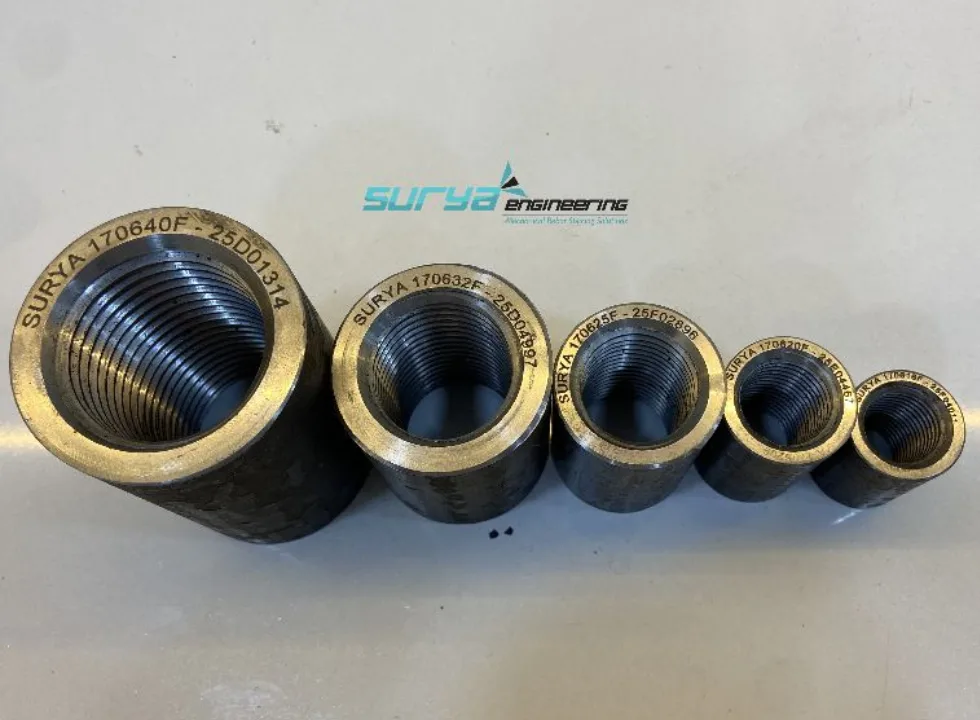
Our parallel threaded coupler is made from EN8D carbon steel and suits 12 mm to 40 mm TMT bars.
- Bar diameters: 12, 16, 20, 25, 28, 32, 36 and 40 mm
- Coupler outer diameter: 21 mm to 62 mm, depending on bar size
- Coupler length: 50 mm to 90 mm
How are rebar couplers tested
A good coupler is judged on three tests:
- Static tensile test: the spliced bar is pulled until it breaks. The bar should break outside the coupler, which shows the joint is not the weak point.
- Slip test: this measures how much the bar moves inside the coupler under load. Our couplers are tested to a slip below 0.10 mm.
- Fatigue test: this checks performance under repeated loading, both low and high cycle.
In India, IS 16172 is the standard for couplers used to splice reinforcing bars. Projects with international specifications often refer to ISO 15835.
What are the limitations of rebar couplers?
- Higher cost per joint: a coupler costs more than a lap splice up front. The savings come from less steel, less time and less congestion.
- Bar preparation: threaded couplers need accurate thread cutting or rolling on the bar ends.
- Size matching: the coupler must match the bar size and thread. A wrong match causes delays or rejection.

How long can a rebar coupler last?
| Factor | What buyers should know |
|---|---|
| Service life | A properly specified and installed coupler can be designed to perform throughout the intended service life of the structure. |
| Material quality | The coupler material and manufacturing quality must meet the applicable specification. |
| Corrosion protection | Moisture, chlorides and aggressive environments can affect durability if protection is inadequate. |
| Installation | Correct bar preparation, thread engagement and assembly are essential. |
| Structural requirements | The coupler must meet the required strength, slip and fatigue performance for its application. |
Does a rebar coupler need replacement?
Rebar couplers embedded in concrete are generally intended to remain in place throughout the structure's design life. They are not routine replacement components. Their long-term performance depends on proper specification, installation, concrete protection and environmental conditions.
Is it compulsory to use rebar couplers?
No. Reinforcement bars can be connected using approved lap splices or mechanical couplers, depending on the structural design. A structural engineer determines which method is suitable for each connection.
Couplers may be preferred when:
Reinforcement is congested in columns or shear walls.
Large-diameter bars make lap splices difficult.
Available space is limited.
The project specification requires mechanical splicing.
Construction sequencing makes conventional lap splicing impractical.
From how many floors should rebar couplers be used?
There is no universal floor-count rule that says couplers must be used from the 5th, 10th or 20th floor.
How many couplers are needed per floor?
The quantity depends on the number of reinforcement bars requiring mechanical splices, the number of splice locations, the structural drawings and the construction method.
For example, if a floor has 40 column bars requiring one coupler each at a specified splice location, that location would require 40 couplers. This is only an illustration, not a standard quantity per floor.
How do you install a rebar coupler?
- Check the bar diameter against the coupler size.
- Inspect the threads for damage, dirt or rust.
- Align the two bars so they are in line.
- Screw the coupler on fully and tighten as per the manufacturer's instructions.
- Inspect the joint before concreting.
How do you choose a rebar coupler manufacturer?
Ask the manufacturer these questions:
- Can you show test reports for tensile, slip and fatigue tests?
- Is each coupler traceable to a raw material and production batch?
- Which bar sizes and grades do you support?
- What are your lead times and production capacity?
- Do you offer technical support?
- Can you share references from past projects?
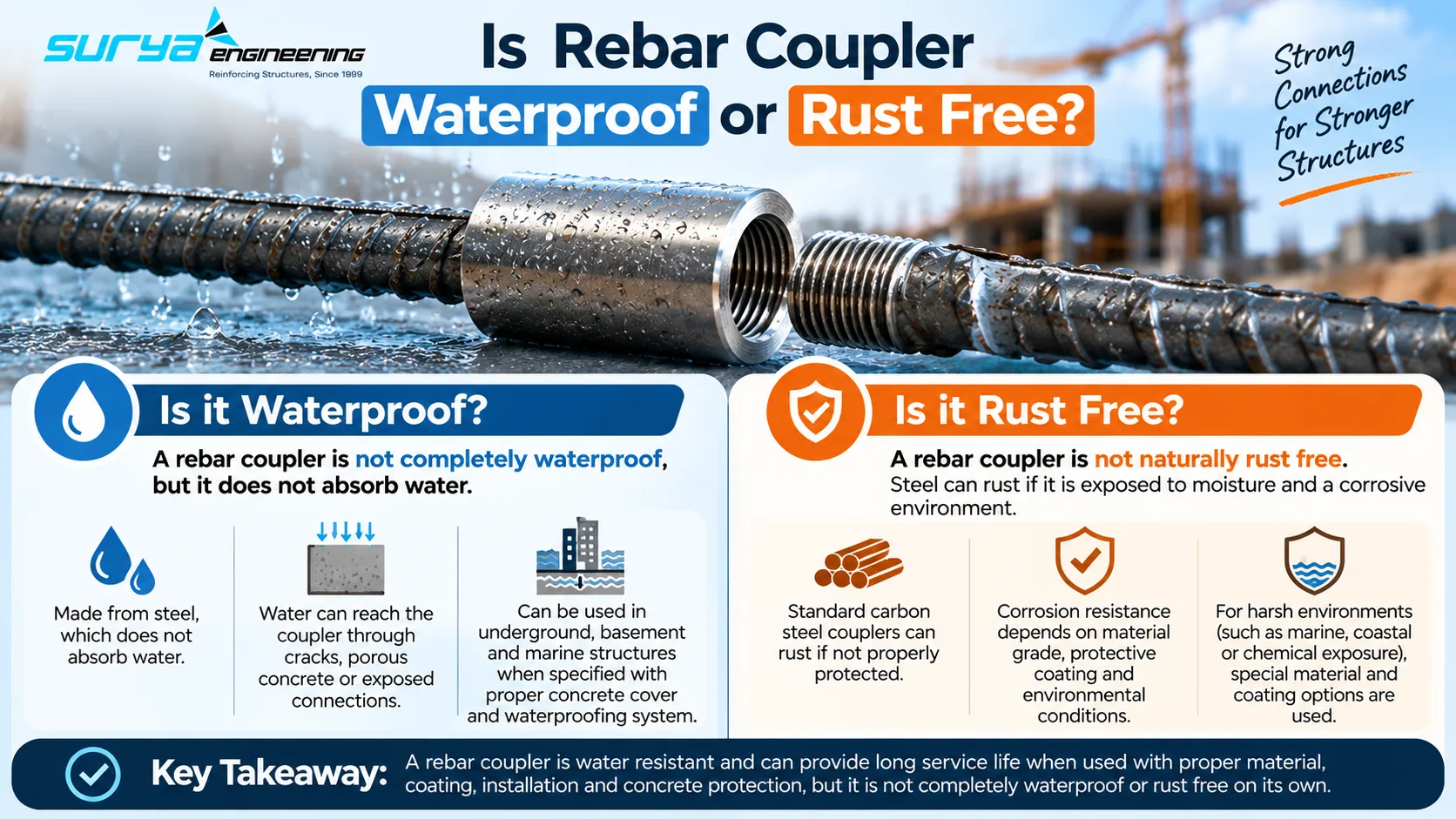
Is a rebar coupler waterproof?
| Property | Explanation |
|---|---|
| Water resistance | The steel coupler itself does not absorb water, but water can reach the connection through surrounding concrete or exposed joints. |
| Corrosion resistance | Depends on the material, coating, exposure conditions and corrosion-protection measures. |
| Waterproofing | Requires a suitable waterproofing system and properly designed concrete details where needed. |
| Underground use | Couplers can be used in foundations, basements and other underground structures when specified appropriately. |
| Marine environments | Requires particular attention to chloride exposure, corrosion protection and project-specific durability requirements. |
Can rebar couplers rust?
Yes. Conventional steel couplers can corrode when exposed to moisture and oxygen, particularly in aggressive environments. Proper concrete cover, sound concrete, suitable materials and specified corrosion-protection measures help protect embedded reinforcement connections.
What should buyers check before purchasing?
Coupler material and any protective coating.
Suitability for underground, coastal or water-retaining structures.
Applicable corrosion-resistance requirements.
Relevant test reports and installation instructions.
Whether the project requires a specialized corrosion-resistant system.
Things rebar coupler buyers really want to know
1. Price per piece — What is the price for each bar diameter, and are GST and delivery included?
2. Available sizes — Are couplers available for 12 mm, 16 mm, 20 mm, 25 mm, 32 mm and other required bar diameters?
3. Types of couplers — Which option is suitable: parallel threaded, cold-forged, taper threaded, position, reducer or MBT?
4. Quality and strength — What load can the connection withstand, and are relevant test reports available?
5. Applicable standards — Does the product meet the project's specified requirements, including applicable provisions of IS 16172:2023?
6. Compatibility with TMT bars — Is the coupler suitable for the required bar diameter, grade and preparation method?
7. Manufacturing quality — Are thread dimensions, material quality, engagement and finished-product inspection controlled?
8. Delivery time — Is the required quantity available, and how quickly can it be delivered to the construction site?
9. Installation requirements — What threading equipment, bar preparation, tools and installation procedures are needed?
10. Manufacturer reliability — Can the supplier provide technical specifications, genuine test documentation, consistent supply and clear after-sales support?
Major Applications of Rebar Couplers in Construction
- High-Rise Buildings: Connects reinforcement bars in RCC columns, shear walls and core structures where mechanical splicing is specified.
- Bridge and Flyover Construction: Used in piers, columns and reinforced concrete components requiring designed mechanical connections.
- Metro and Railway Infrastructure: Suitable for reinforcement connections in metro stations, elevated viaducts and other railway structures.
- Pile Foundations: Used in reinforcement cages for bored piles and other foundation systems where the approved design permits mechanical splicing.
- Earthquake-Resistant Structures: Specified in structural systems requiring couplers with the appropriate cyclic performance and installation controls.
- Industrial Buildings: Used in factory structures, power plants, warehouses and heavy-duty RCC construction.
- Basement and Retaining Walls: Helps connect reinforcement in retaining walls, diaphragm walls and underground structures.
- Precast Concrete Construction: Supports designed reinforcement connections in precast elements and modular concrete assemblies.
- Water and Hydraulic Structures: Used in suitable reinforced concrete structures such as water tanks, treatment plants and dams, according to project specifications.
- Congested Reinforcement Zones: Can reduce bar overlap and local reinforcement congestion in columns, beam-column joints and heavily reinforced sections when approved by the structural engineer.
Can rebar couplers be used under Indian codes?
Mechanical splices are used in Indian construction when the coupler meets the relevant standard and the project's structural engineer approves it. Always confirm with your structural consultant before specifying a coupler.
Problems Faced When Construction Projects Do Not Use Rebar Couplers?
1. Higher Reinforcement Congestion
Lap splicing requires reinforcing bars to overlap over a specified length. In heavily reinforced columns, walls and beam-column joints, this can create congestion and make concrete placement more difficult.
2. Additional Reinforcement Steel
Lap splices use extra bar length to achieve the required overlap. Depending on the structural design, mechanical couplers may reduce this additional reinforcement requirement.
3. Difficult Concrete Placement
Closely spaced overlapping bars can restrict the flow and compaction of concrete, increasing the importance of suitable reinforcement detailing and proper concreting practices.
4. Limited Space for Reinforcement Connections
In narrow columns, shear walls, foundations and other congested areas, arranging overlapping bars can be difficult. A suitable mechanical coupler may provide a more compact connection.
5. More Complicated Reinforcement Detailing
Repeated lap splices can complicate bar placement and detailing, particularly in structures with large reinforcement diameters or limited working space.
6. Difficulties With Bar Alignment
Positioning overlapping reinforcement can be challenging in some construction conditions. Properly selected mechanical couplers can simplify connections where bar overlap or rotation is impractical.
7. Increased Installation Work in Certain Applications
Preparing, positioning and securing lap splices can require additional handling and labour. A suitable coupler system may streamline installation, although it also requires the correct preparation equipment and assembly procedure.
8. Challenges in Precast and Staged Construction
Where reinforcement connections must be completed between separately cast or sequentially constructed elements, lap splicing may be impractical. Approved mechanical connection systems can offer an alternative.
How Rebar Couplers Help
Rebar couplers provide a mechanical alternative to lap splicing when permitted by the structural design. They can reduce overlap-related congestion, simplify selected reinforcement connections and help manage reinforcement installation in restricted spaces.
However, couplers must be correctly specified, installed and inspected. They are not automatically more economical or suitable than lap splicing in every project.
For reliable results, consult the structural engineer and select couplers that meet the applicable project requirements and relevant performance standards.
ways to check whether a rebar coupler manufacturer is genuine
- Verify the company's GST number
- Verify BIS certification claims
- Ask for genuine test reports
- Check the actual manufacturing facility
- Inspect the coupler samples
- Request a formal quotation and invoice
- Check past project references
- Start with a controlled sample order
Why Choose Surya Engineering for Rebar Couplers?
Surya Engineering s a manufacturer and exporter based in Sakinaka, Mumbai offers a range of rebar couplers designed for different reinforcement connection requirements in construction and infrastructure projects. With options including parallel roll-threaded, cold-forged, taper-threaded, position, reducer and MBT couplers, buyers can explore suitable solutions based on bar diameter, installation conditions and project specifications.
What makes Surya Engineering worth considering?
- Multiple Coupler Types: Different connection options for varied reinforcement and site requirements.
- Wide Size Selection: Coupler options for common TMT bar diameters, with specific sizes subject to product availability.
- Manufacturing Expertise: Access to rebar threading and cold-forging machinery alongside coupler products.
- Project-Based Selection: Product enquiries based on bar diameter, reinforcement grade and connection requirements.
- Quality Documentation: our certificates are published on our Quality Assurance page
- Direct Quotation: Discuss required quantities, product specifications, pricing and delivery arrangements directly with the company.
For contractors, builders and infrastructure developers, choosing a rebar coupler supplier involves more than comparing prices. Product compatibility, installation requirements, documented performance and dependable supply are equally important.
About Surya Engineering
Surya Engineering is a manufacturer and exporter based in Sakinaka, Mumbai, with over 12 years of experience. We make rebar couplers, rebar threading machines and other rebar processing and construction products. We supply across India, including Mumbai, Pune, Delhi NCR, Bangalore, Hyderabad, Chennai, Kolkata and Ahmedabad.
Get a quote or view our rebar coupler range.
Frequently asked questions
What is a rebar coupler?
A rebar coupler is a steel sleeve that joins two reinforcement bars end to end without overlap.
Is a rebar coupler as strong as the bar?
A properly made and tested coupler is designed so that the bar breaks outside the coupler in a tensile test. Ask your manufacturer for test reports.
Coupler or lap splice: which is better?
Couplers save steel and reduce congestion, which suits heavy bars and dense sections. Lap splices cost less per joint and suit small, light jobs.
What bar sizes do you supply?
We supply couplers for 12 mm to 40 mm TMT bars.
Do you supply outside Mumbai?
Yes. We supply across India.
