High-Strength Mechanical Splicing System for TMT Bars
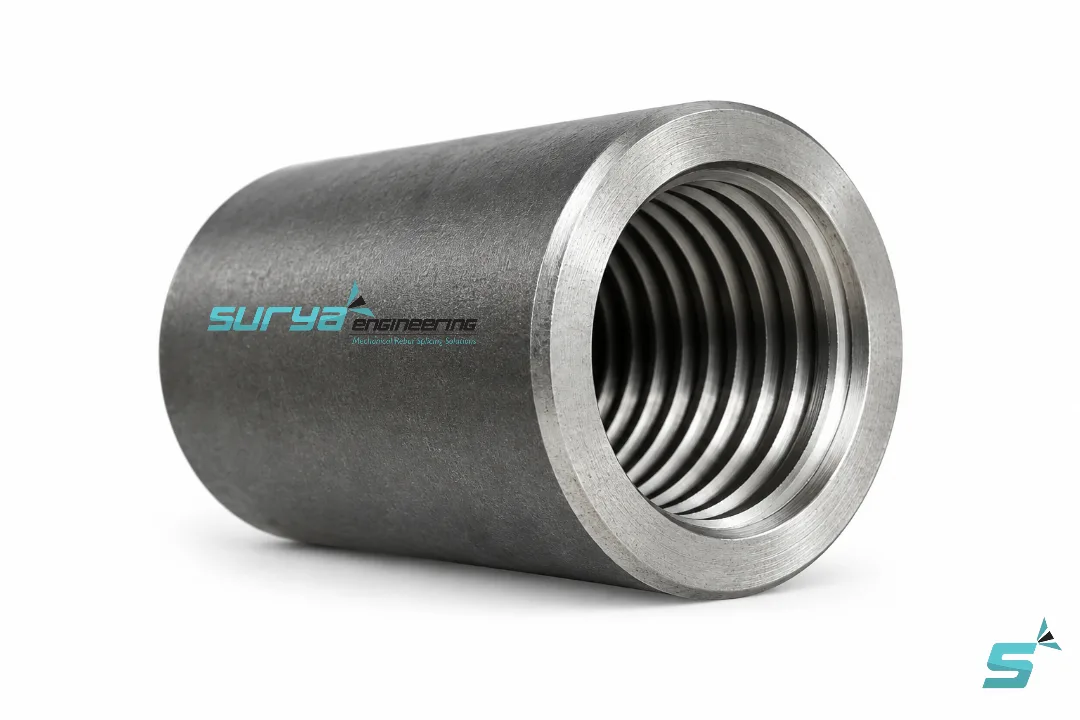
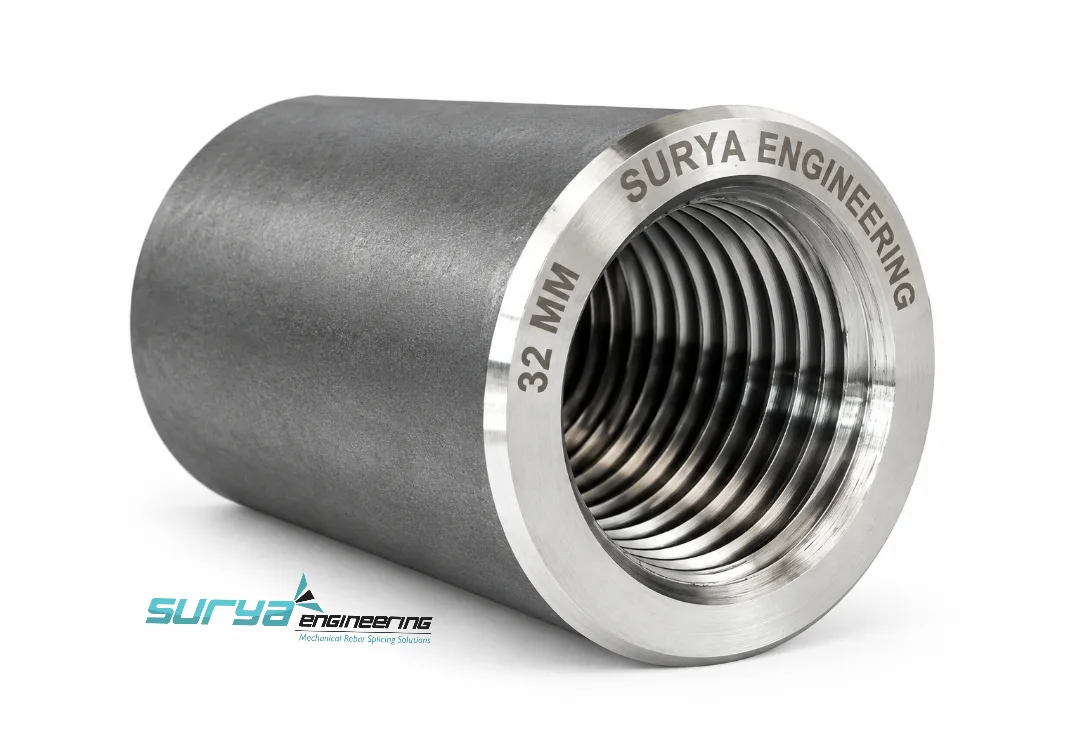
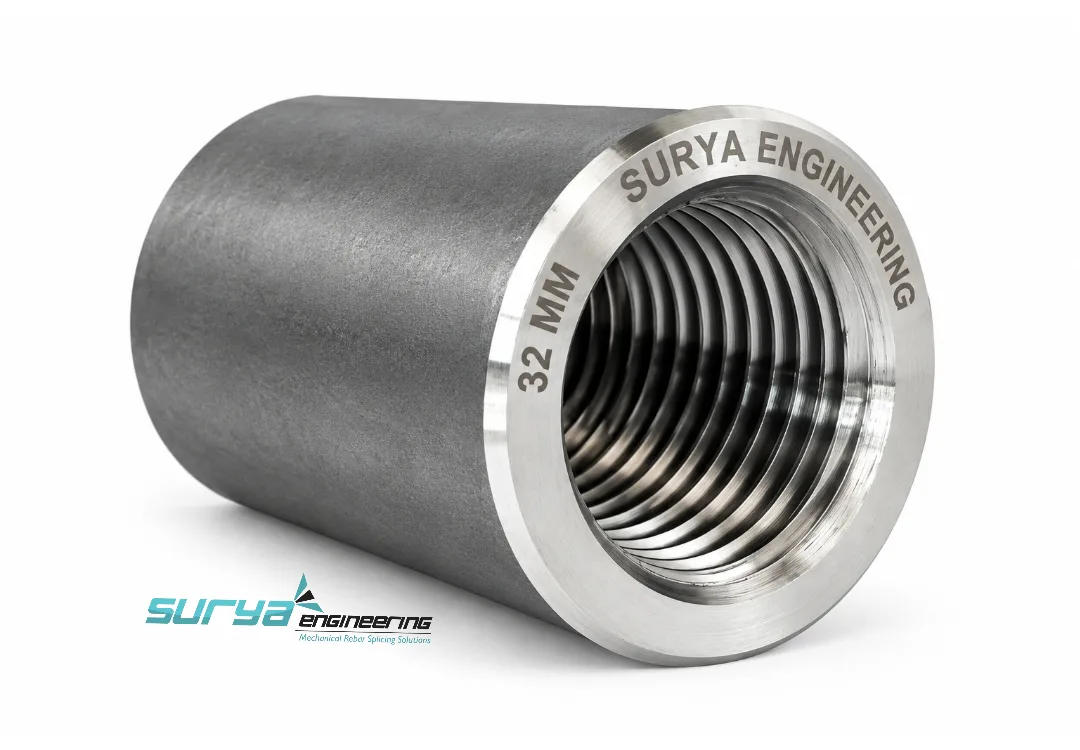
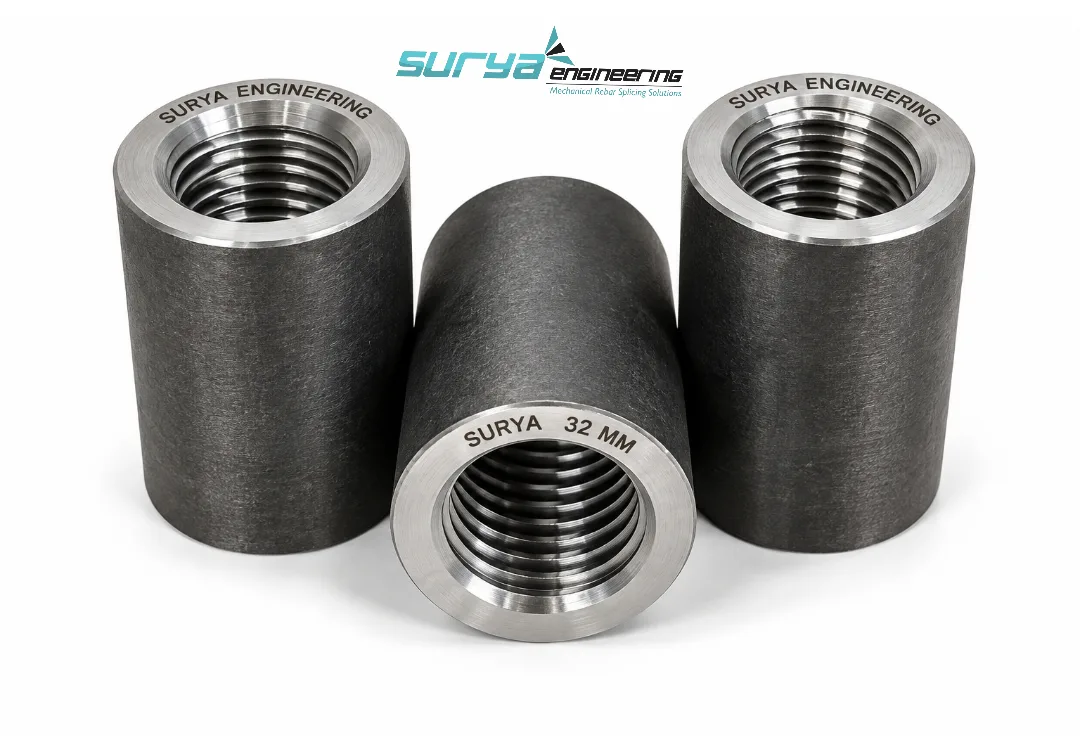
The Cold Forged Rebar Coupler from Surya Engineering is a Type 2 mechanical splicing solution manufactured by cold forging process as per IS 16172:2014. Made from high-tensile EN8D carbon steel, it ensures maximum strength and ductility without heating the material.
Product Media
The Surya Engineering Cold Forged Rebar Coupler represents the pinnacle of mechanical splicing technology. Unlike standard machined couplers that cut away steel fibers, our cold-forged couplers are manufactured by reshaping the steel at room temperature. This process induces "work hardening," aligning the steel's internal grain structure to dramatically increase its yield strength and fatigue resistance. It is the ideal solution for seismic zones, bridges, and dynamic load-bearing structures.
Unlike hot forged couplers, cold forging maintains the grain structure of steel, resulting in higher tensile strength, better dimensional accuracy, and superior performance in cyclic and fatigue tests.
Traditional reinforcement bar lap splicing requires overlapping bars over a specified length. In heavily reinforced structural members, this can increase reinforcement congestion and make concrete placement more difficult.
A cold forged rebar coupler provides a mechanical connection between compatible reinforcement bars without requiring the same overlapping arrangement as conventional lap splicing. This can be useful in areas where reinforcement space is limited and a compact connection is preferred.
Superior Fatigue Resistance: The cold-forging process creates a continuous grain flow, making it highly resistant to cyclic loading and vibration.
Increased Tensile Strength: Work hardening significantly boosts the coupler's overall yield strength compared to traditional methods.
Eliminates Lap Splicing: Reduces rebar overlap, saving significant amounts of steel and reducing overall project costs.
No Material Removal: Unlike machined couplers, cold forging does not cut away steel fibers, maintaining maximum structural integrity.
Accelerated Construction: Quick and easy installation speeds up formwork and concrete pouring schedules.
Cold forged rebar couplers provide mechanical connections between reinforcement bars where conventional lap splicing may be difficult or where reinforcement congestion needs to be controlled. The suitable coupler configuration depends on bar diameter, reinforcement layout and project requirements.
Used to connect reinforcement bars of the same diameter in standard applications.
Used to connect reinforcement bars of different diameters where the coupler system is specifically designed and tested for the required combination.
Used where reinforcement bars cannot be freely rotated during installation and the connection must be positioned accurately.
Used with reinforcement bars whose ends are cold-forged or upset before threading. The forged bar end provides the required geometry for the threaded mechanical connection.
Available Rebar Sizes: 12mm, 16mm, 20mm, 25mm, 28mm, 32mm, 36mm and 40mm, subject to product availability and project requirements.
Cold forging is a metal-forming process in which steel is shaped under controlled pressure without heating the material to forging temperatures. The process can provide consistent dimensions and controlled manufacturing of the coupler body.
The finished coupler should undergo appropriate dimensional and quality checks according to the applicable product specification and project requirements.
For structural applications, rebar couplers should be manufactured and tested according to the applicable project specifications and relevant standards.
Depending on the specified coupler system, quality checks may include:
Surya Engineering can provide applicable technical and testing documentation according to project requirements.
| Parameter | Specification |
|---|---|
| Product Name | Cold Forged Rebar Coupler |
| Material | High-Grade Carbon Steel |
| Manufacturing Process | Cold Forging |
| Rebar Diameter Range | 12mm – 40mm |
| Thread Type | Parallel Thread |
| Connection Type | Mechanical Threaded Connection |
| Tensile Strength | Equal to or Greater Than Parent Rebar* |
| Surface Finish | Natural / Zinc Coated |
| Installation | Threaded Connection |
| Application | RCC Construction & Infrastructure |
| Reusability | No |
| Corrosion Protection | Optional Zinc Coating Available |
Cutting a TMT Bar
The end of the reinforcing bar is sawn square. The TMT Bar should be cut at 90 degrees at the end of the reinforcement bar.
Cold forging of TMT Bar
The sawn end of the reinforcing bar is then enlarged by the cold forging process the core diameter of the bar is increased to a pre-determined diameter.
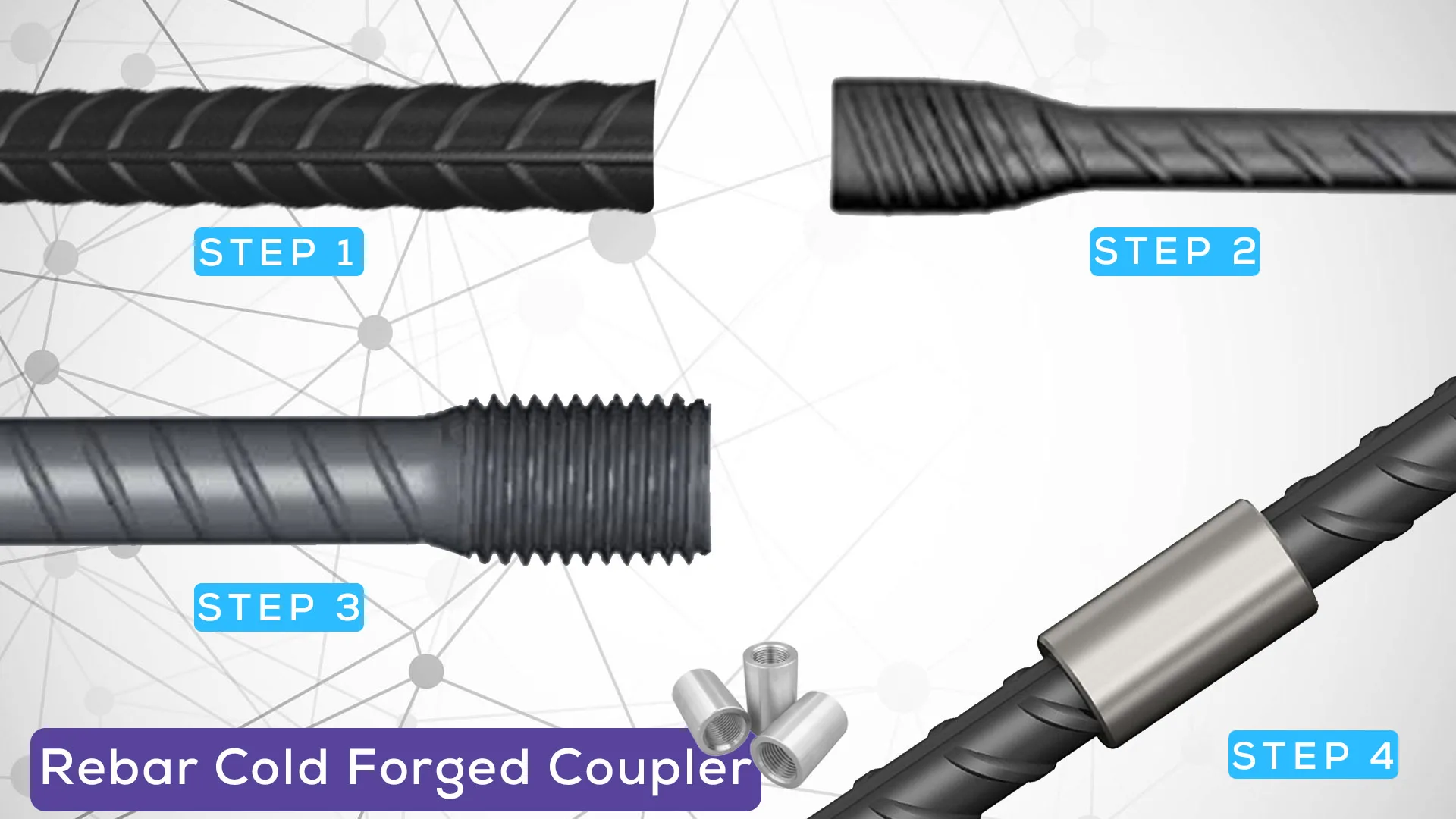
Threading on TMT Bar
Finally, the Rebar threading machine is mechanically cut onto the enlarged end of the bar.
Fixing of TMT Bar Coupler
The Rebar coupler is ready to join the TMT Bars.
Go/No-Go gauge inspection is an important dimensional quality check for threaded rebar couplers. It helps verify that the manufactured thread profile is within the specified dimensional limits and that the mating components can achieve the required engagement.
The GO side must pass through the specified thread profile as required by the applicable gauge specification.
The NO-GO side must not pass beyond the specified permissible limit.
Surya Engineering supplies cold forged rebar couplers, mechanical rebar couplers and reinforcement connection products for construction and infrastructure projects across India. We support contractors, structural consultants, EPC companies, builders and infrastructure developers with product selection, technical information and project-oriented supply.
Mumbai, Thane, Pune, Nashik, Navi Mumbai, Ahmedabad, Vadodara, Surat, Rajkot and Nagpur.
Delhi NCR, Noida, Gurugram, Chandigarh, Jaipur, Lucknow, Kanpur, Varanasi and Ludhiana.
Bengaluru, Chennai, Hyderabad, Coimbatore, Kochi, Vijayawada, Visakhapatnam and Mangaluru.
Kolkata, Bhubaneswar, Ranchi, Jamshedpur, Patna and Dhanbad.
Indore, Bhopal, Raipur, Agra, Prayagraj, Goa and other project locations across India.
A forged rebar coupler is a mechanical reinforcement-bar connector manufactured by forming steel under compressive force to achieve the required coupler shape and dimensions. In a cold-forged rebar coupler, the material is formed at or near room temperature. A common approach for rebar couplers is to upset or enlarge the bar end before preparing the connection, depending on the product design. Cold forging processes include operations such as upsetting and extrusion.
Rebar couplers are available in different designs depending on the connection method and project requirements. Under IS 16172:2023, BIS identifies these coupler types:
The standard also classifies couplers as Class H and Class L, based on the applicable fatigue requirements.
Cold forging uses dies and compressive forces to shape metal without heating it to conventional hot-forging temperatures. Common cold-forging operations include:
| Cold Forging Process | What it does |
|---|---|
| Upsetting | Increases cross-sectional area by compressing the material length |
| Forward Extrusion | Forces material through a die in the direction of the punch |
| Backward Extrusion | Material flows in the opposite direction to the punch |
| Side Extrusion | Material flows laterally through a die |
| Heading | Forms or enlarges an end section; often treated as a type of upsetting |
There are multiple manufacturers and suppliers of rebar couplers in India. Current web listings identify companies including Surya Engineering (Mumbai), Innovegic (Rajkot), and Specialized Construction Technology Services (Navi Mumbai) as manufacturers of rebar-coupling products. Trade-industry listings also show other manufacturers and suppliers across Mumbai, Gujarat, Punjab and other locations.
Technical Details
Where It's Used
We manufacture to order. Contact our team with your requirements and we'll provide a tailored quote.
Customer Reviews
No reviews yet — be the first to share your experience with this product.
Explore similar engineering products from Surya Engineering.