High-Strength Mechanical Splicing Without Bar End Threading or Prepping
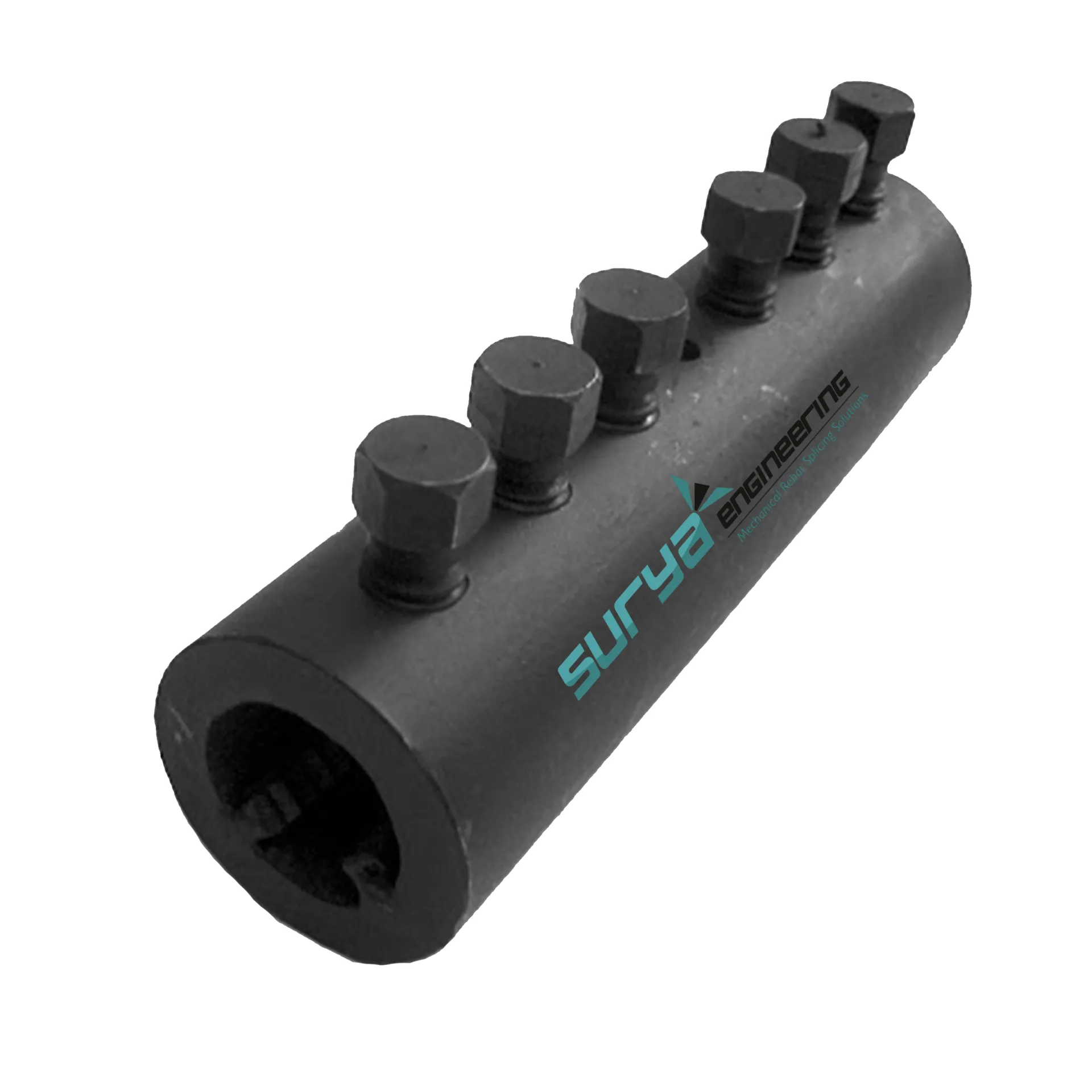
High-strength MBT Bolted Rebar Coupler for joining 12-40mm TMT bars without threading or welding. Features lock-shear bolts that shear off at preset torque and serrated saddles for superior grip. Ideal for congested RCC, beam-column joints, bridges, metro, tunnels and retrofit work.
Product Media
A Bolted Rebar Coupler is a mechanical rebar splicing system used to connect two reinforcing steel bars end-to-end without welding or overlapping the reinforcement. It provides a strong and reliable connection for reinforced concrete structures while helping reduce steel congestion and simplify reinforcement installation.
Bolted rebar couplers are particularly useful where conventional lap splicing is difficult, uneconomical, or requires additional reinforcement length. The coupler connects the bars through high-strength bolts that grip the reinforcement and transfer the required tensile and compressive forces through the mechanical connection.
Surya Engineering manufactures and supplies bolted rebar couplers for a wide range of construction and infrastructure applications, with product selection based on rebar diameter, connection requirements, project specifications, and applicable testing requirements.
A bolted rebar coupler generally consists of a high-strength steel sleeve/body and specially designed locking bolts. The two reinforcing bars are positioned inside the coupler, and the bolts are tightened to securely grip the bars.
Depending on the coupler design, the tightening mechanism may mechanically lock the reinforcement inside the sleeve and create a dependable load-transfer connection. This eliminates the need for conventional lap lengths and can make reinforcement fixing faster and easier on site.
The mechanical connection can reduce the need for long reinforcement overlaps, helping save reinforcement steel and making bar placement more efficient where the design permits.
Because the connection does not require traditional lap lengths, it can help create more compact reinforcement arrangements, particularly in heavily reinforced structural zones.
Bolted couplers can be installed on site using suitable tools and the specified tightening procedure, which can reduce installation complexity compared with some conventional joining methods.
Unlike threaded rebar couplers, bolted couplers generally connect reinforcement without requiring threaded bar ends, making them suitable for applications where bar threading is undesirable or impractical.
The installation method can be advantageous in areas where access is limited and conventional lap splicing is difficult.
When the correct coupler, rebar size, installation procedure, and tightening requirements are followed, the connection is designed to transfer structural forces through mechanical engagement.
Replacing lap joints with mechanical couplings can help reduce reinforcement overlap and improve the utilization of available reinforcement space.
| Feature | Bolted Rebar Coupler | Conventional Lap Splice |
|---|---|---|
| Connection Method | Mechanical bolted connection | Reinforcing bars overlap |
| Rebar Threading | Usually not required | Not required |
| Welding | Not required | Not required |
| Lap Length | Typically not required as a conventional lap | Required according to design |
| Reinforcement Congestion | Can reduce congestion | Can increase congestion |
| Installation | Mechanical installation | Bar tying and positioning |
| Steel Consumption | Can reduce overlap-related steel | Additional steel required for lap |
| Restricted Areas | Useful where space is limited | May be difficult in congested areas |
| Rebar Diameter Options | Various sizes depending on design | Depends on reinforcement design |
| Application | New construction, repair, extension | Conventional reinforced concrete construction |
The installation procedure should always follow the manufacturer's approved installation instructions and the project engineer's requirements.
Step 1 – Prepare the Reinforcement
Ensure the ends of both reinforcing bars are reasonably straight, clean, and free from excessive rust, oil, concrete, or other contaminants that may affect proper installation.
Step 2 – Position the Coupler
Insert the reinforcing bars into the coupler body to the specified insertion depth.
Step 3 – Align the Bars
Check that both bars are correctly aligned and positioned inside the coupler.
Step 4 – Tighten the Bolts
Tighten the locking bolts using the specified sequence and approved tool. Where required, follow the manufacturer's specified torque or bolt-shearing procedure.
Step 5 – Inspect the Connection
Inspect the installed coupler to confirm correct bar insertion, bolt installation, and completion of the tightening process.
Step 6 – Final Verification
Where required by the project specification, perform inspection, sampling, or mechanical testing to verify connection performance.
The performance requirements of a bolted rebar coupler depend on its design, reinforcement grade, diameter range, and the applicable project or national standard.
Typical quality-control and performance checks may include:
| Test / Inspection | Purpose |
|---|---|
| Dimensional Inspection | Verifies coupler dimensions and manufacturing tolerances |
| Material Inspection | Checks the specified material and mechanical properties |
| Visual Inspection | Identifies surface defects, damage, or manufacturing issues |
| Tensile Test | Evaluates the strength of the mechanical connection |
| Slip / Deformation Test | Evaluates connection movement under specified loading |
| Thread / Bolt Inspection | Verifies bolt condition and engagement where applicable |
| Installation Inspection | Confirms correct bar insertion and bolt tightening |
| Batch / Production Testing | Supports consistency of manufactured couplers |
Testing and acceptance should be carried out according to the applicable Indian or international standard and the project's approved technical specification.
Surya Engineering provides mechanical rebar connection solutions intended for modern reinforced concrete construction. Our bolted rebar couplers are designed for applications where dependable mechanical splicing, reduced reinforcement congestion, and efficient installation are important.
Product selection can be made according to rebar diameter, grade, connection type, structural requirements, and project specifications. Customers can also request technical information, dimensional details, installation instructions, and applicable test documentation for project evaluation.
| Rebar Size / Diameter | Coupler Outer Diameter (Approx.) | Coupler Length (Approx.) | No. of Bolts / Screws |
|---|---|---|---|
| 12 mm | 33.5 mm | 140 mm | 4 |
| 16 mm | 42.5–48 mm | 140–160 mm | 6 |
| 20 mm | 48.5–52 mm | 200–204 mm | 8 |
| 25 mm | 54–62 mm | 240–258 mm | 8 |
| 32 mm | 71-83 mm | 280–312 mm | 8 |
| 40 mm | 81-95 mm | 425–484 mm | 12 |
A Bolted Rebar Coupler is a mechanical rebar splicing device used to connect two reinforcing steel bars end-to-end. It uses high-strength bolts to securely grip and lock the rebars, providing a mechanical connection without conventional lap splicing.
Typically, no rebar threading is required for a bolted rebar coupler. The bars are mechanically secured inside the coupler using locking bolts.
A mechanical coupler can be used instead of a conventional lap splice where the structural design, applicable standard, and project specification permit it. The appropriate coupler must be selected for the rebar diameter and required connection performance.
Yes. Their mechanical installation can be useful in congested reinforcement zones and locations where providing a conventional lap splice is difficult.
Bolted rebar couplers are generally manufactured using high-strength steel or other specified structural-grade materials for the coupler body and locking components. Exact material grades depend on the manufacturer's design and specification.
The suitability depends on the specific coupler design and its approved performance requirements. The selected coupler should be verified for the required tensile and compressive load conditions of the project.
Technical Details
Where It's Used
We manufacture to order. Contact our team with your requirements and we'll provide a tailored quote.
Customer Reviews
No reviews yet — be the first to share your experience with this product.
Explore similar engineering products from Surya Engineering.