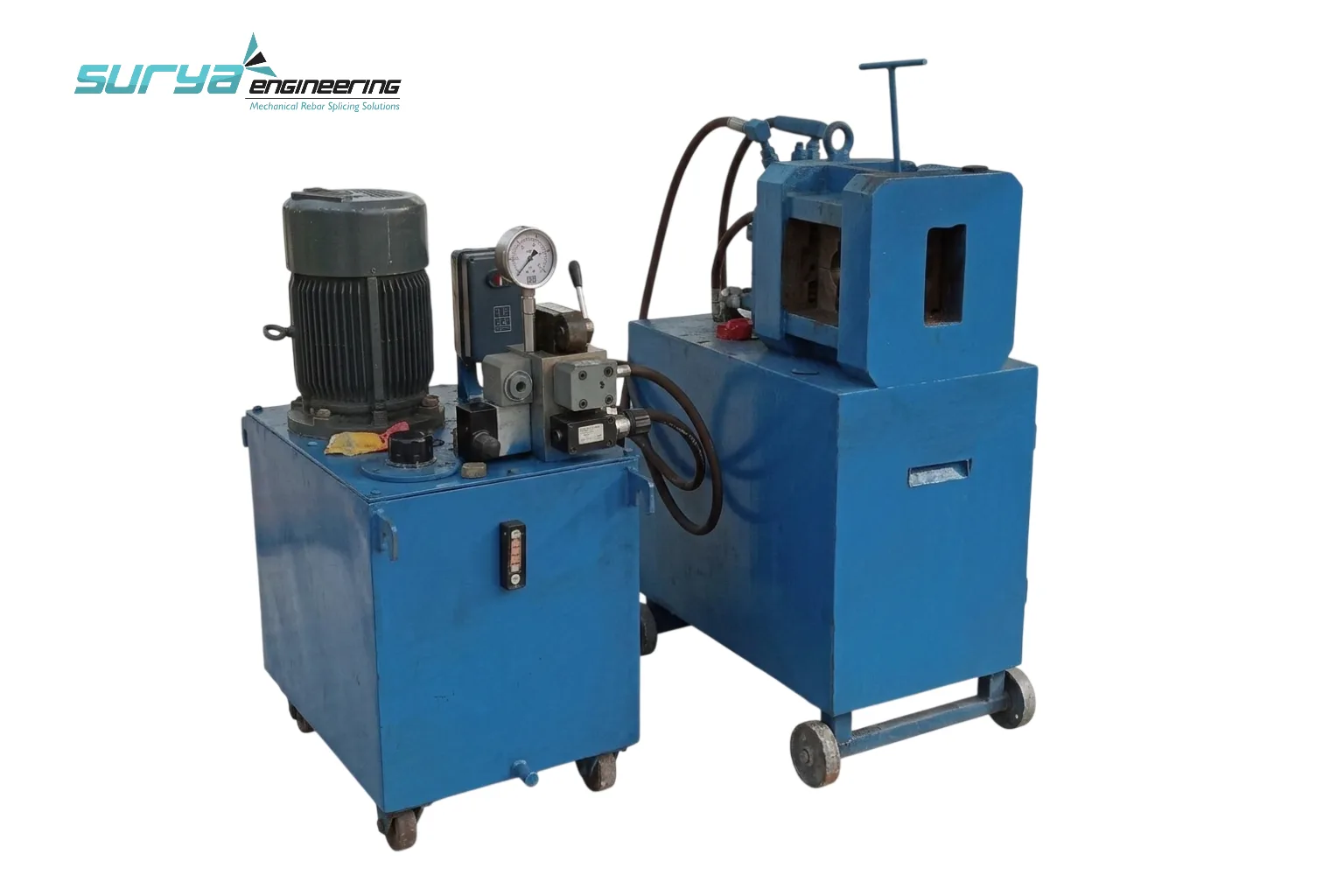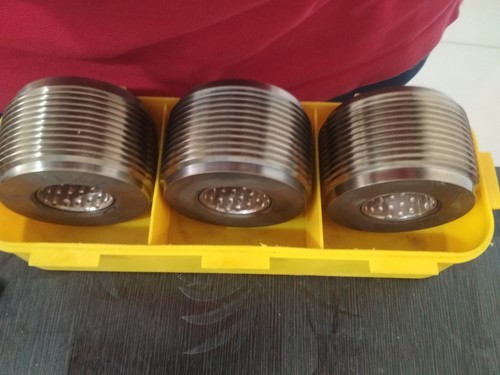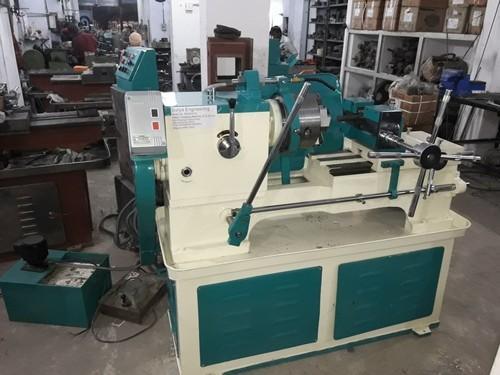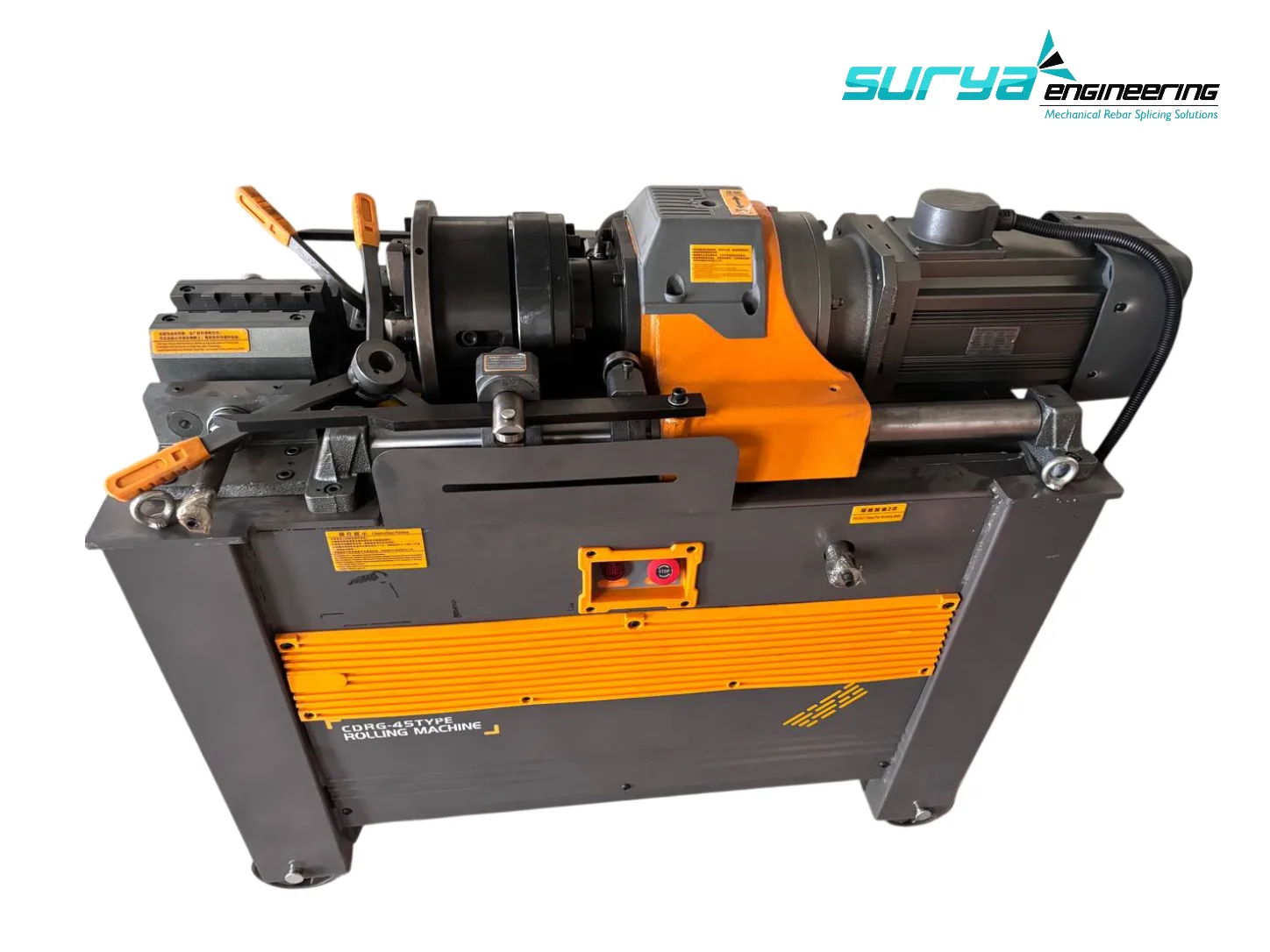
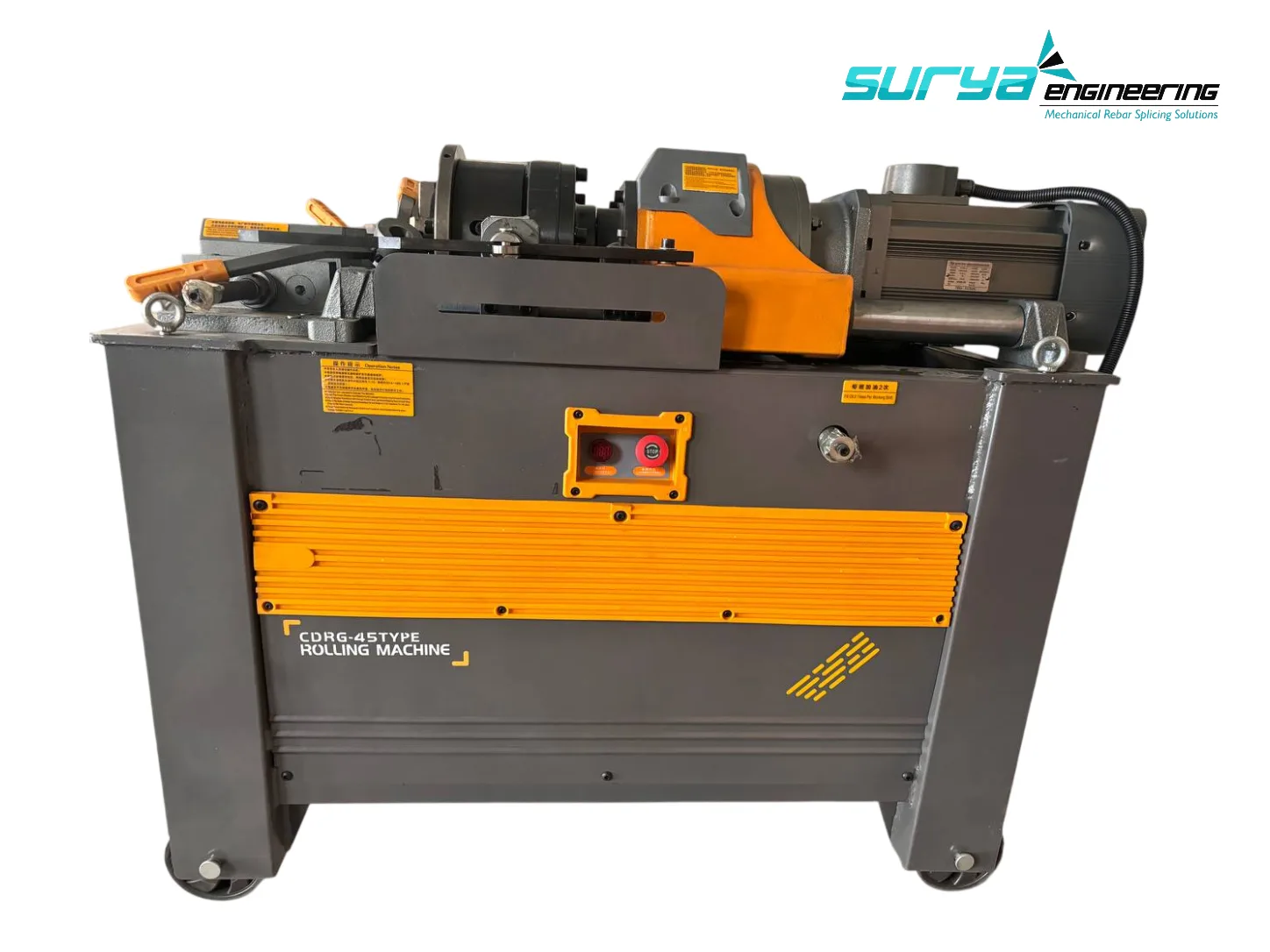
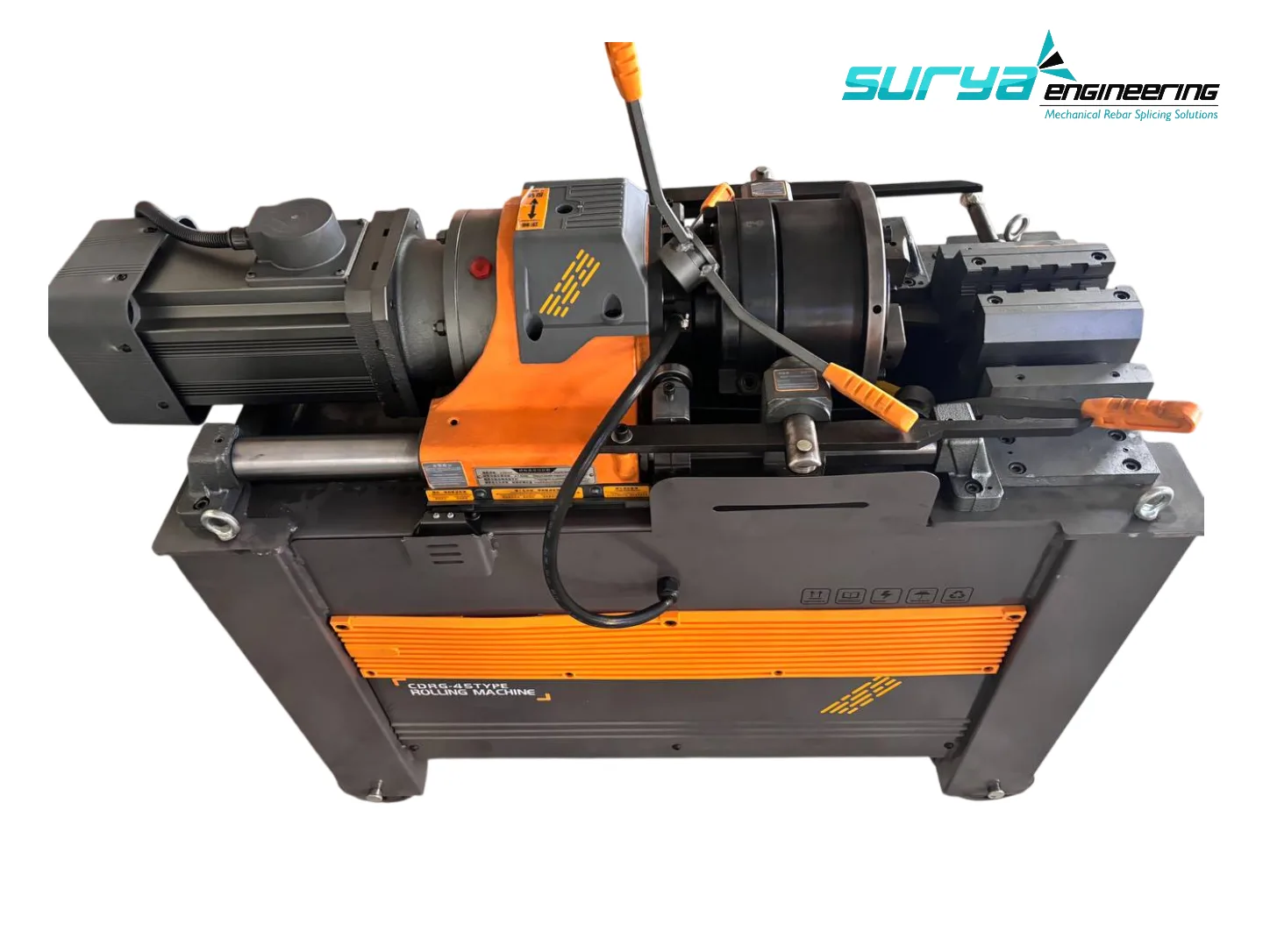
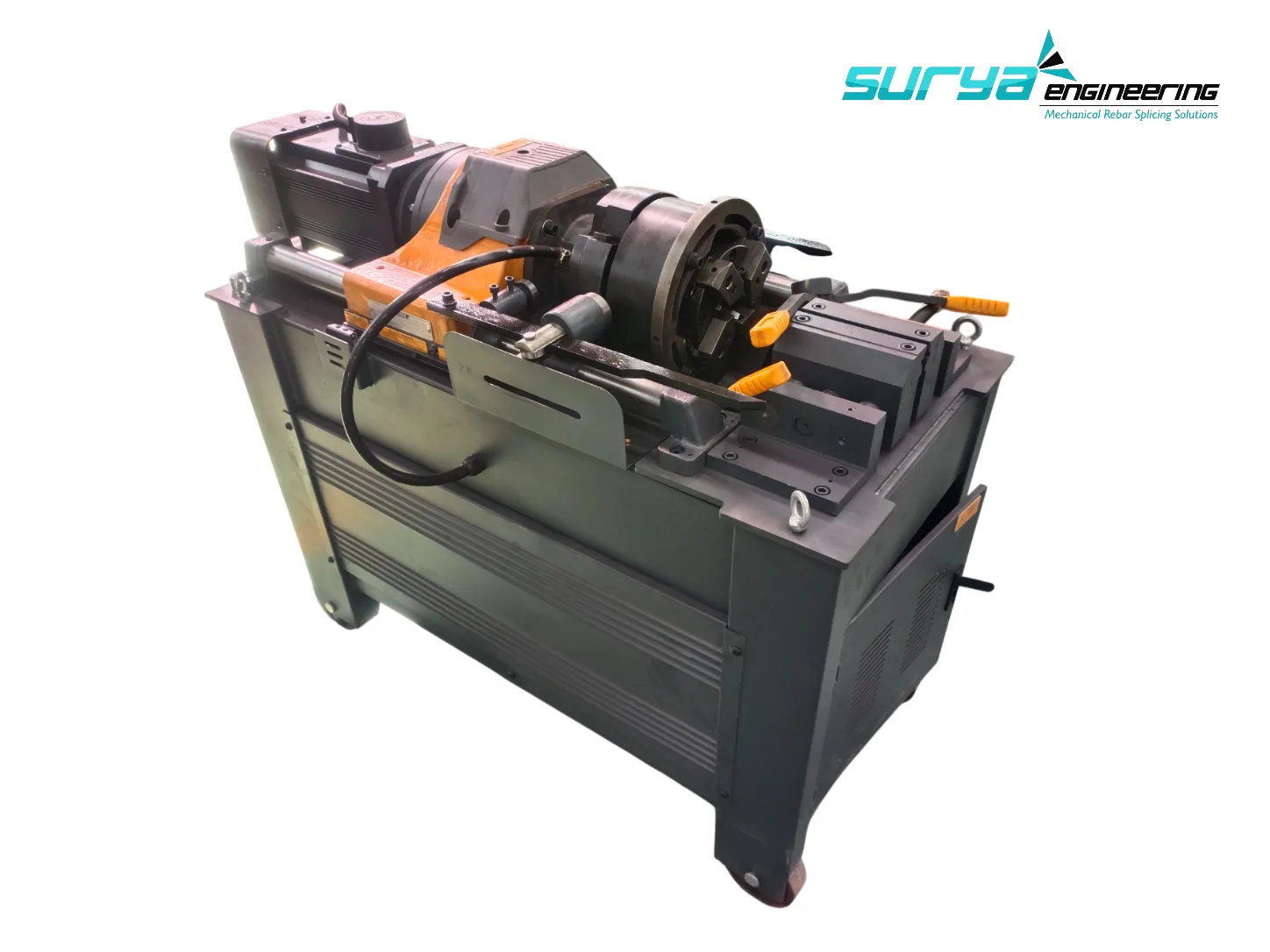
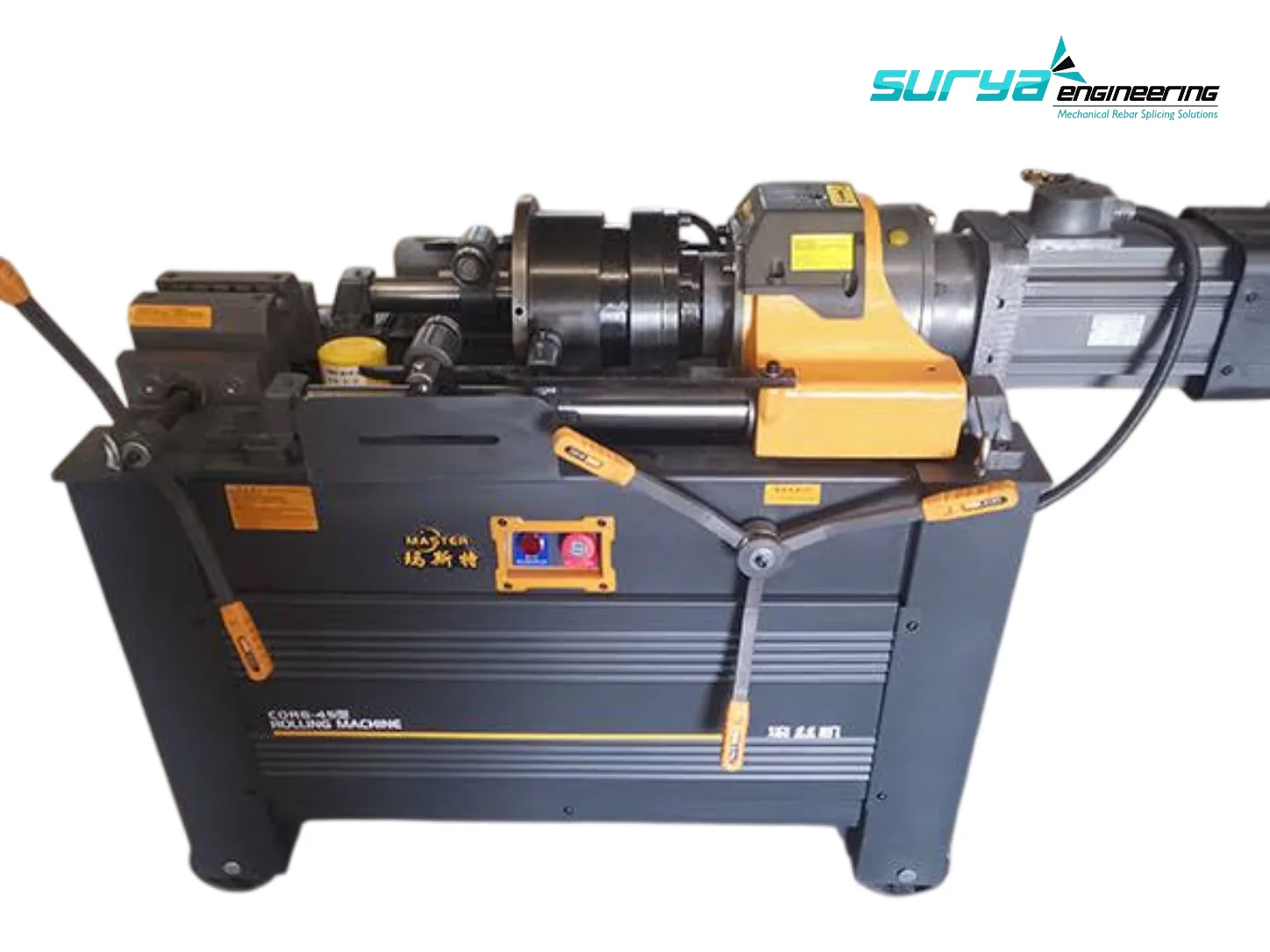
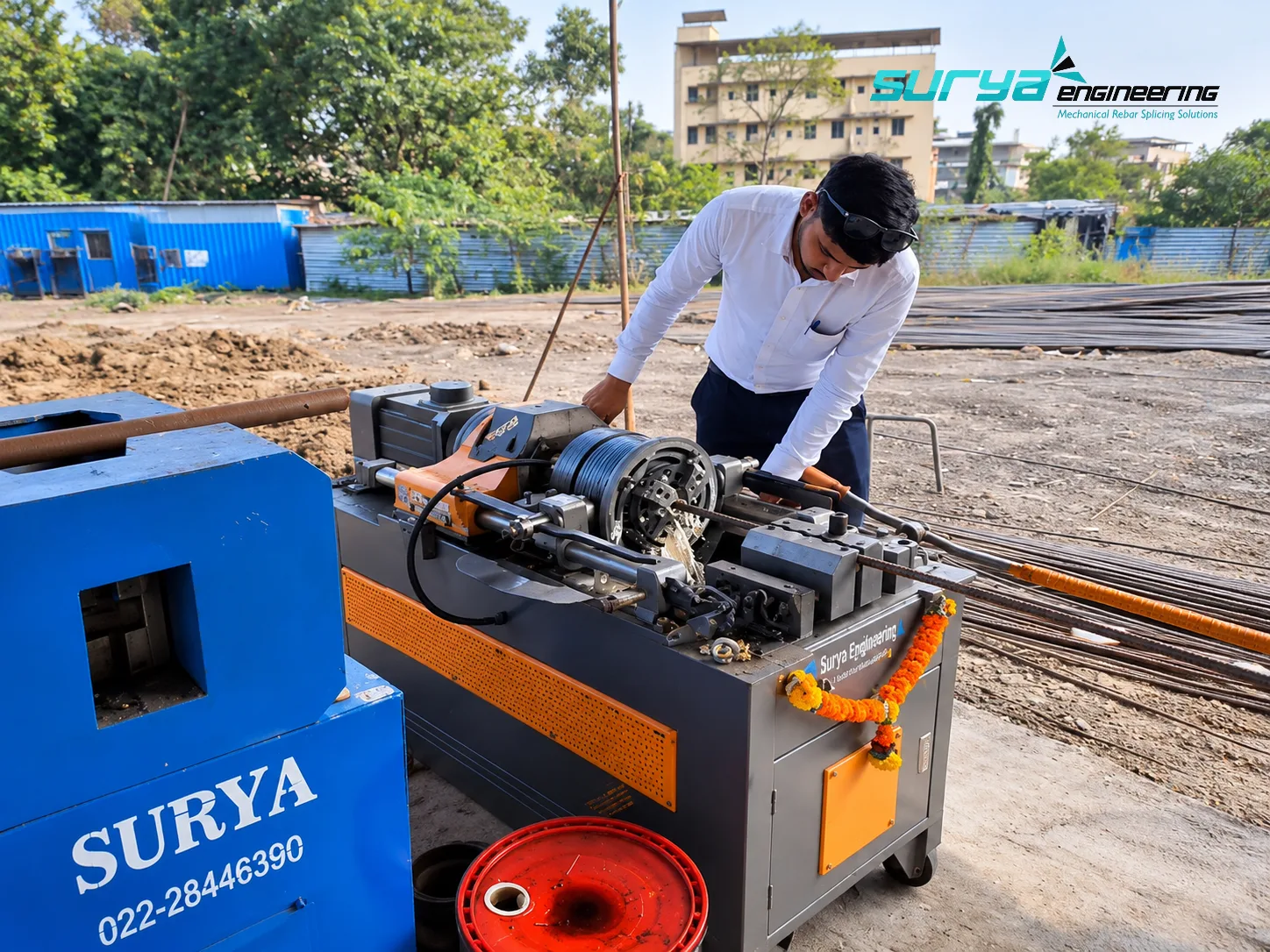
Heavy-duty parallel thread rolling & rib peeling for 16mm–40mm Fe 500D/550D/600 TMT bars — IS 16172 compliant splicing.
Heavy-duty Rebar Threading Machine manufactured in India for 16mm to 40mm TMT bars (Fe 500D, Fe 550D, Fe 600). Engineered for cold roll threading, rib peeling, and parallel thread cutting to produce IS 16172 compliant mechanical coupler joints.
Product Media
You've ordered couplers for your 25 mm bars, and the bars on site still have bare sawn ends. A rebar threading machine closes that gap by putting a thread on each bar end so the coupler can screw on. Surya Engineering is a rebar threading machine manufacturer in India, based in Chandivali, Sakinaka, Mumbai. This page explains how bar-end threading works and what to check before you choose a machine.
A coupler only works if the thread on the bar end matches the thread inside the coupler. The machine makes that thread, one bar end at a time, in a yard or on site. Surya Engineering's rebar threading machine handles 12 to 40 mm bars, and the table below lists its specifications.
| Specification | Detail |
|---|---|
| Bar diameter range | 12 mm to 40 mm |
| Thread type | Parallel or taper |
| Thread pitch | As per IS or BS standard |
| Power supply | Single phase or three phase |
| Motor power | 1.5 kW to 7.5 kW |
| Thread length | 25 mm to 80 mm |
Capacity is the first filter when you compare machines. Marketplace listings show chaser machines for 10 to 32 mm bars and machines for 16 to 40 mm bars, so the same words on a listing can mean different jobs.
Rebar has little steel to spare. A US threaded-rod supplier's FAQ on threading rebar works through the arithmetic: the body of a #8 bar measures 0.960 inch between ribs, about 24.4 mm, while a full 1 inch thread needs a major diameter of at least 0.9755 inch, about 24.8 mm. Cut a thread straight into that bar and you cannot get a complete thread.
The STRUCTURE magazine review gives the structural reason. Direct threading is usually avoided because it reduces the bar size and with it the strength, and one fix is to enlarge the bar end before threading. The same review notes that some systems need two machines, a forging machine and a thread cutting machine, plus skilled operators.
Unbrako, an Indian coupler maker, describes the sequence for its upset parallel system: saw the bar end square, cold forge it to enlarge the end, thread the enlarged end, then protect the thread with a plastic cap. It also says to add a nominal length to each bar for the steel that cutting and forging use up. Unbrako adds that parallel threads cut the risk of cross-threading and mismatch.
Cutting and rolling are different ways to make the thread itself. A threading supplier explains that cutting removes material from a full diameter bar, while rolling is cold forming that removes none and starts from a smaller diameter. Ask any supplier which one their machine does, and whether you need a forging press as well.
Surya's rebar threading machine suits work on site and in the yard:
A rebar threading machine prepares the ends of reinforcement bars for mechanical splicing using rebar couplers. The process involves several steps:
Bar cutting: Cut the reinforcement bar to the required length and prepare a square end.
Bar-end preparation: Prepare the bar end according to the coupler system's requirements. Some systems require cold forging or upsetting before threading.
Machine setup: Select the appropriate threading die or cutting tool according to the bar diameter and specified thread.
Threading operation: Position and secure the bar in the machine, then produce the required thread.
Thread inspection: Check thread dimensions, length and surface condition.
Thread protection: Fit a protective cap to prevent damage and corrosion during storage and transportation.
Coupler installation: Connect the prepared bar to the matching coupler according to the coupler manufacturer's installation instructions.
Feature | Roll Thread (Parallel) | Taper Thread |
Thread Shape | Straight (Parallel) cylinder. | Angled (Conical) taper (5^\circ–6^\circ). |
How It’s Made | Pressed (Cold-Rolled): Ribs are peeled, then rollers press threads without cutting steel fibers. | Cut (Shaved): Cutting blades carve metal away to form a tapered thread. |
Joint Strength | Higher: Compresses and strengthens the steel; passes strict seismic/fatigue tests (IS 16172). | Slightly Lower: Cutting removes metal at the thread root, reducing cross-sectional area. |
Site Installation | No Torque Wrench Needed: Visual check (tighten until threads disappear). | Torque Wrench Mandatory: Must be tightened to exact Nm specs or it can slip. |
Tool Life | Long: Rollers last 2,000–5,000+ ends. | Short: Cutting blades dull fast (500–1,200 ends). |
Machine type | Suitable application |
|---|---|
Manual threading machine | Smaller-scale threading operations |
Semi-automatic threading machine | Regular fabrication and construction work |
Automatic threading machine | Higher-volume production requirements |
Price is a poor first filter. IndiaMART listings for rebar threading machines run from ₹41,262 to ₹5,00,000, and they describe the machines as manual, semi-automatic or automatic, with different capacities. The rupee figure alone tells you little.
Ask these instead:
On a working line the bar goes from sawn end to threaded end to capped end, and the cap stays on until the coupler goes on. The STRUCTURE review says threaded ends need protecting from corrosion in the meantime, and that the installation takes care to get the threads to fit. A cap is cheap. A rusted thread is a slow afternoon.
Wide bar-size compatibility: Designed to process reinforcement bars from 12 mm to 40 mm, subject to the selected machine configuration.
Threading options: Supports the specified parallel and taper threading configurations.
Industrial motor options: Available with motor ratings ranging from 1.5 kW to 7.5 kW.
Power supply options: Configurations available for single-phase or three-phase electrical supplies.
Construction-site applications: Suitable for reinforcement preparation in construction projects and fabrication yards.
Coupler compatibility: Thread specifications can be selected according to the compatible coupler system.
Which bar sizes does the machine handle?
12 mm to 40 mm, with thread lengths from 25 mm to 80 mm.
Can one machine thread bars for any coupler?
Only if its thread matches the coupler's. This one threads parallel or taper to IS or BS pitch, so confirm which thread your coupler has before you order either one.
Do I need a forging press too?
It depends on the coupler system. Upset systems enlarge the bar end first. Ask the supplier of your coupler which route it uses.
How much extra bar length does threading use?
Unbrako says to allow a nominal extra length per threaded end. Ask your supplier for the figure at your bar size and plan your cutting list around it.
What do I send for a quote?
The bar diameter range, how many bar ends you thread, the site power supply and the coupler thread type.
Check your site's power supply first, single phase or three phase. It narrows the field faster than price does.
Surya Engineering makes rebar couplers and rebar threading machines in Chandivali, Sakinaka, Mumbai. To enquire, send the details above through suryaengineer.com.
Technical Details
Where It's Used
We manufacture to order. Contact our team with your requirements and we'll provide a tailored quote.
Customer Reviews
No reviews yet — be the first to share your experience with this product.
Explore similar engineering products from Surya Engineering.