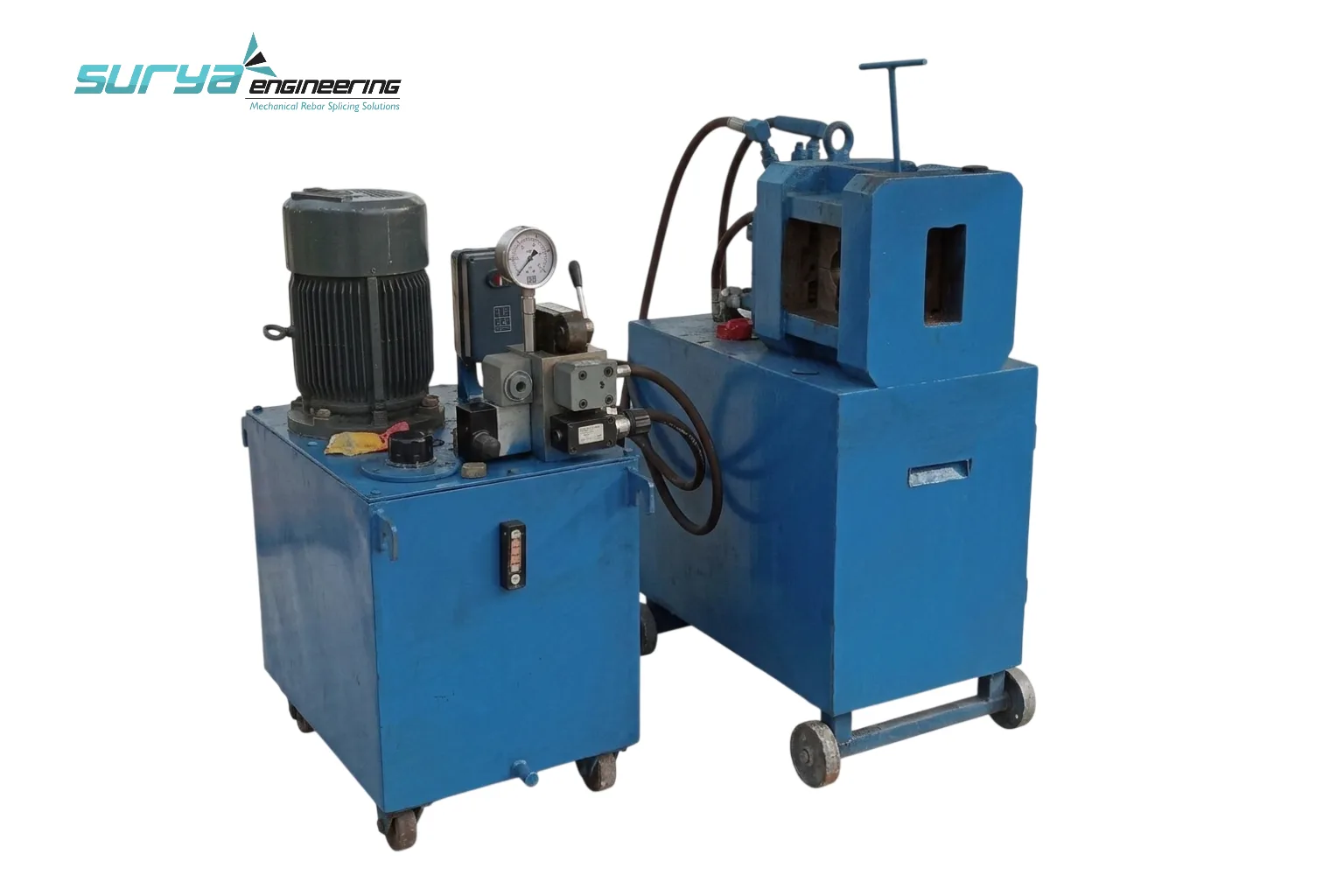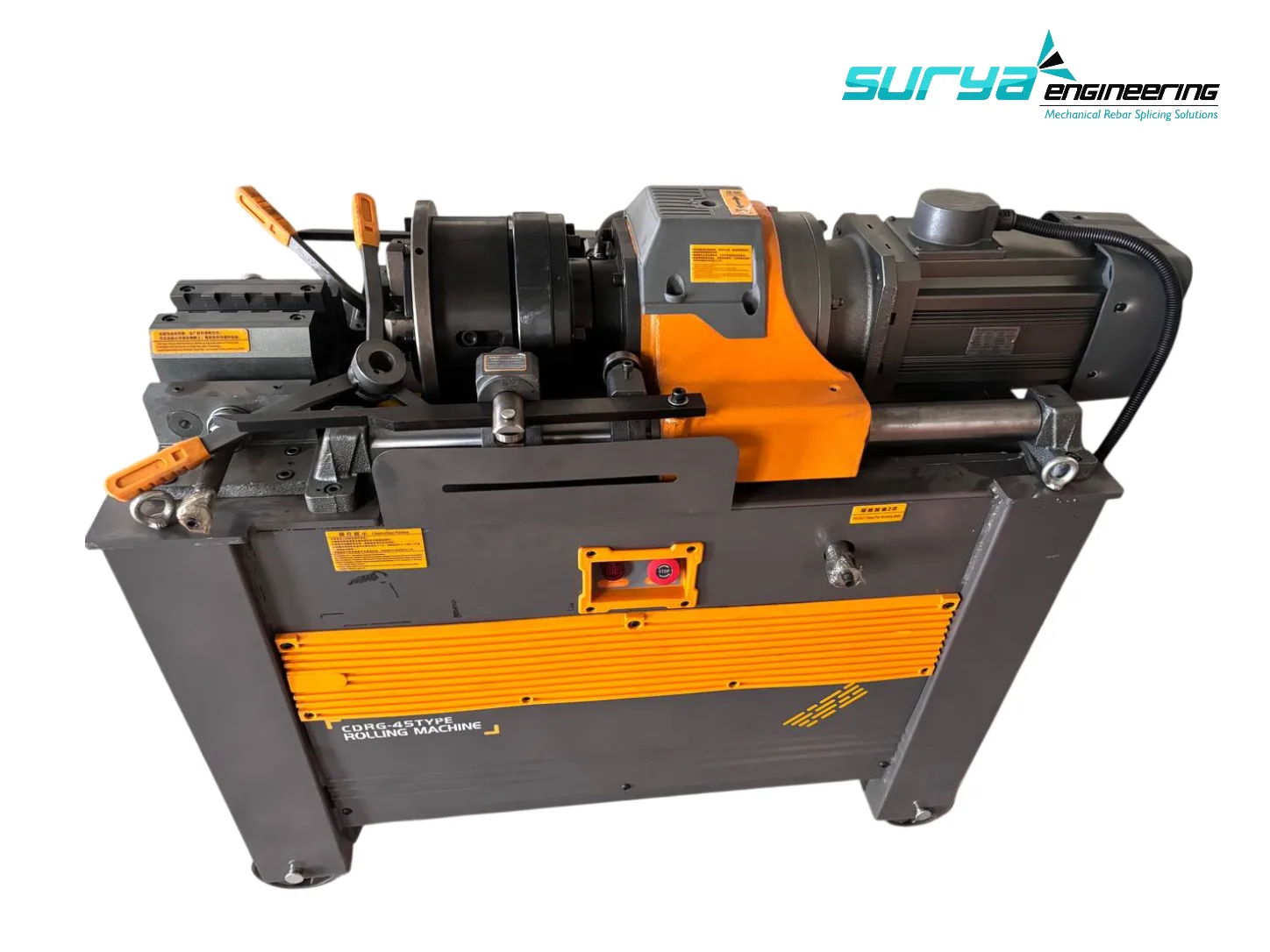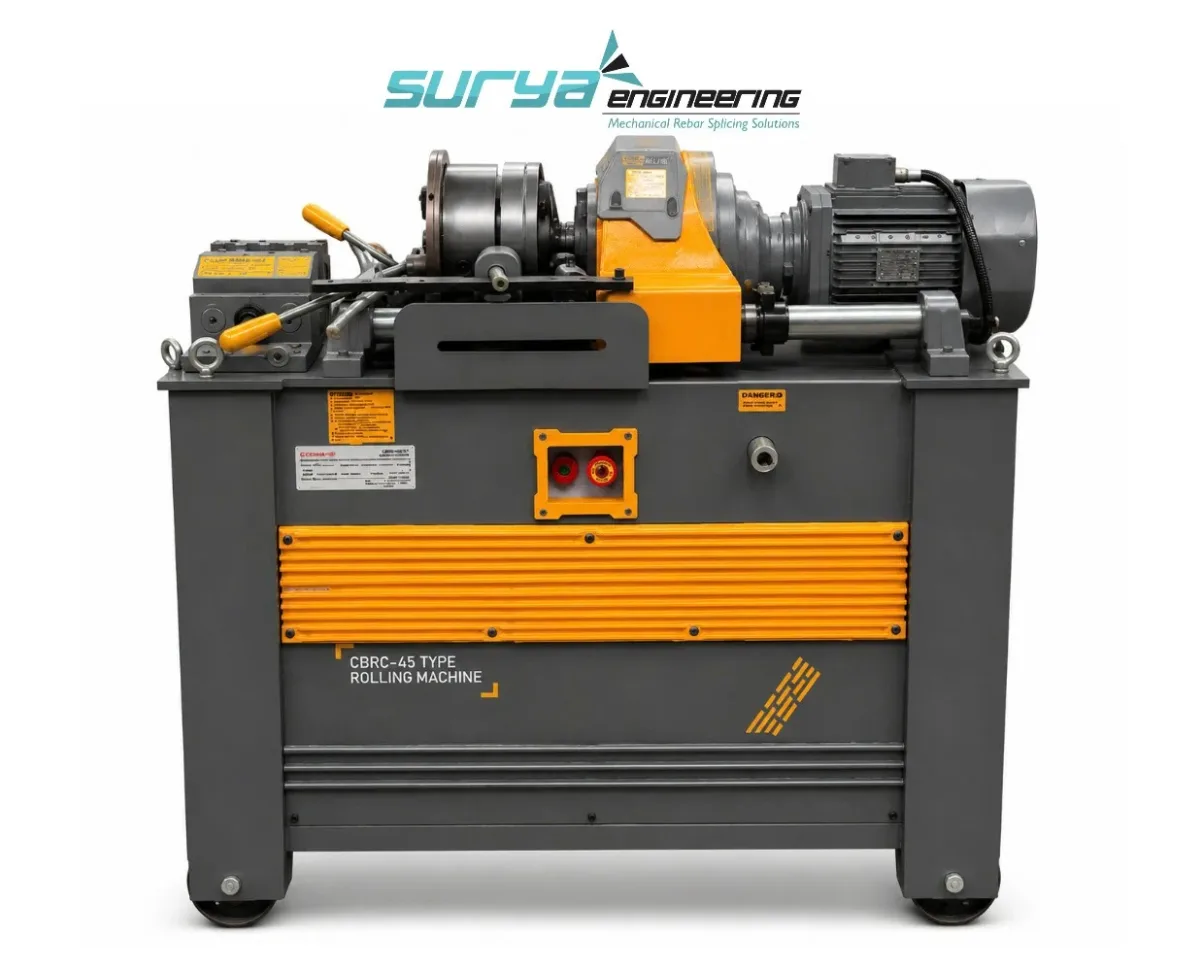
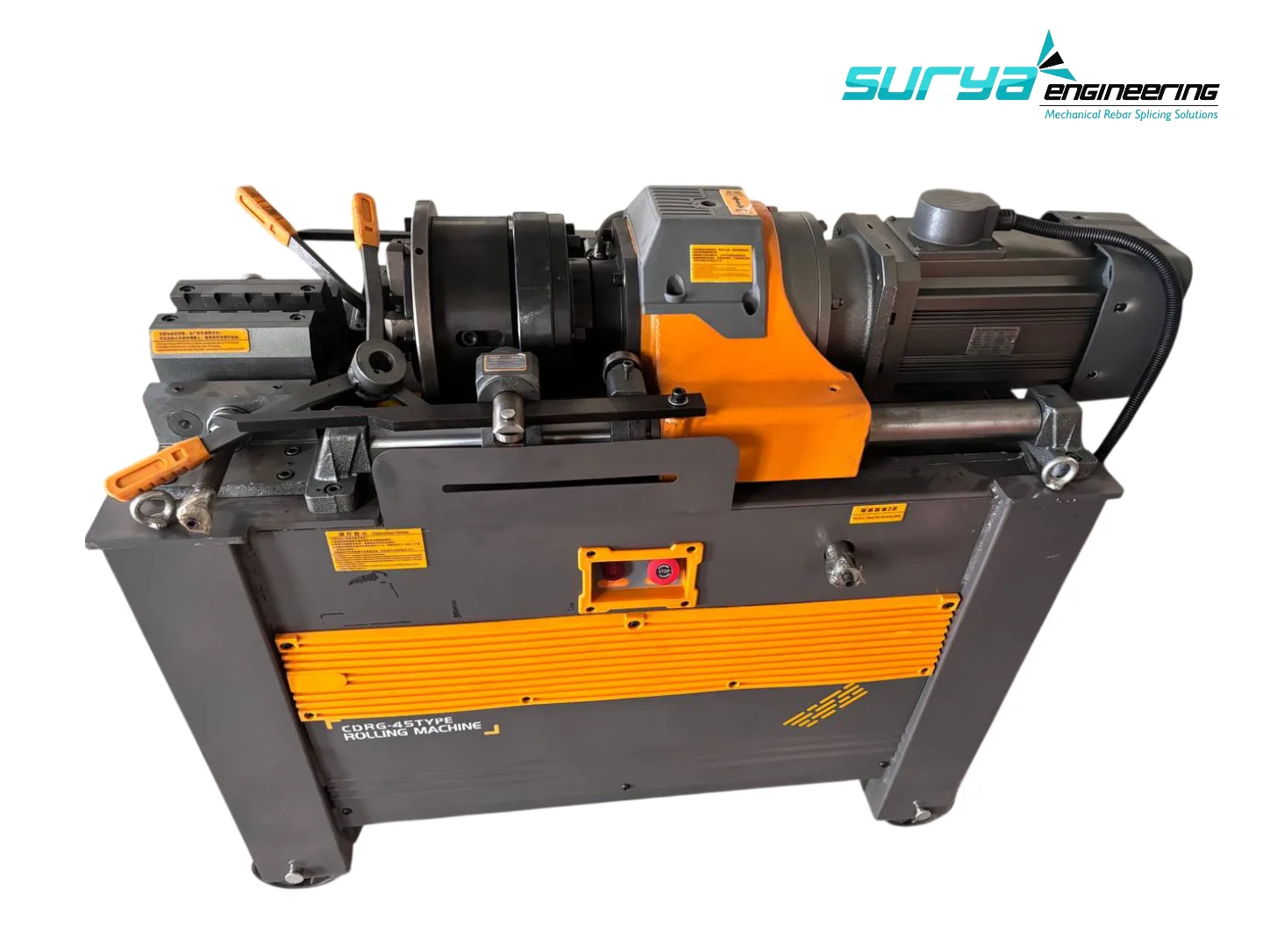
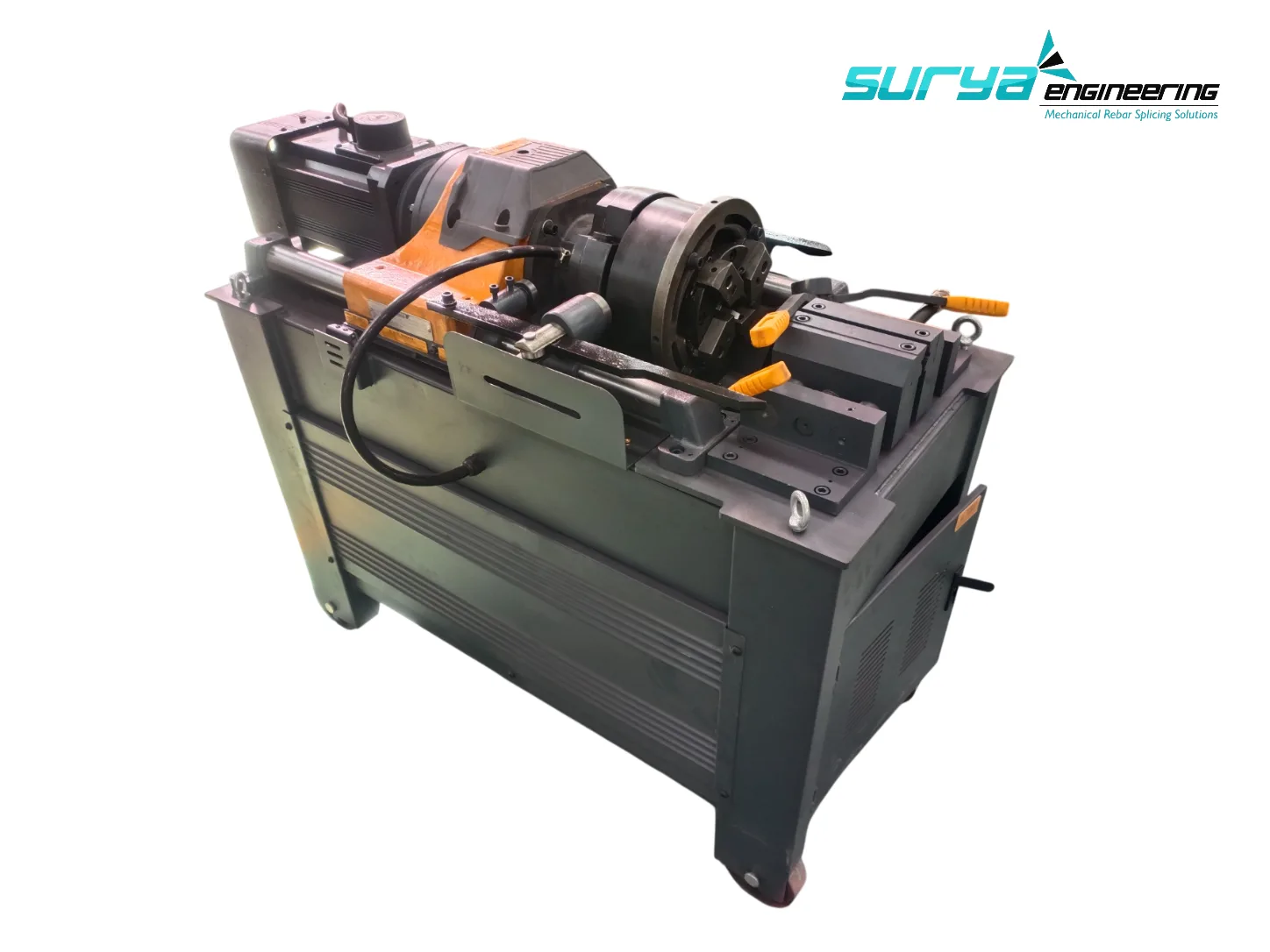
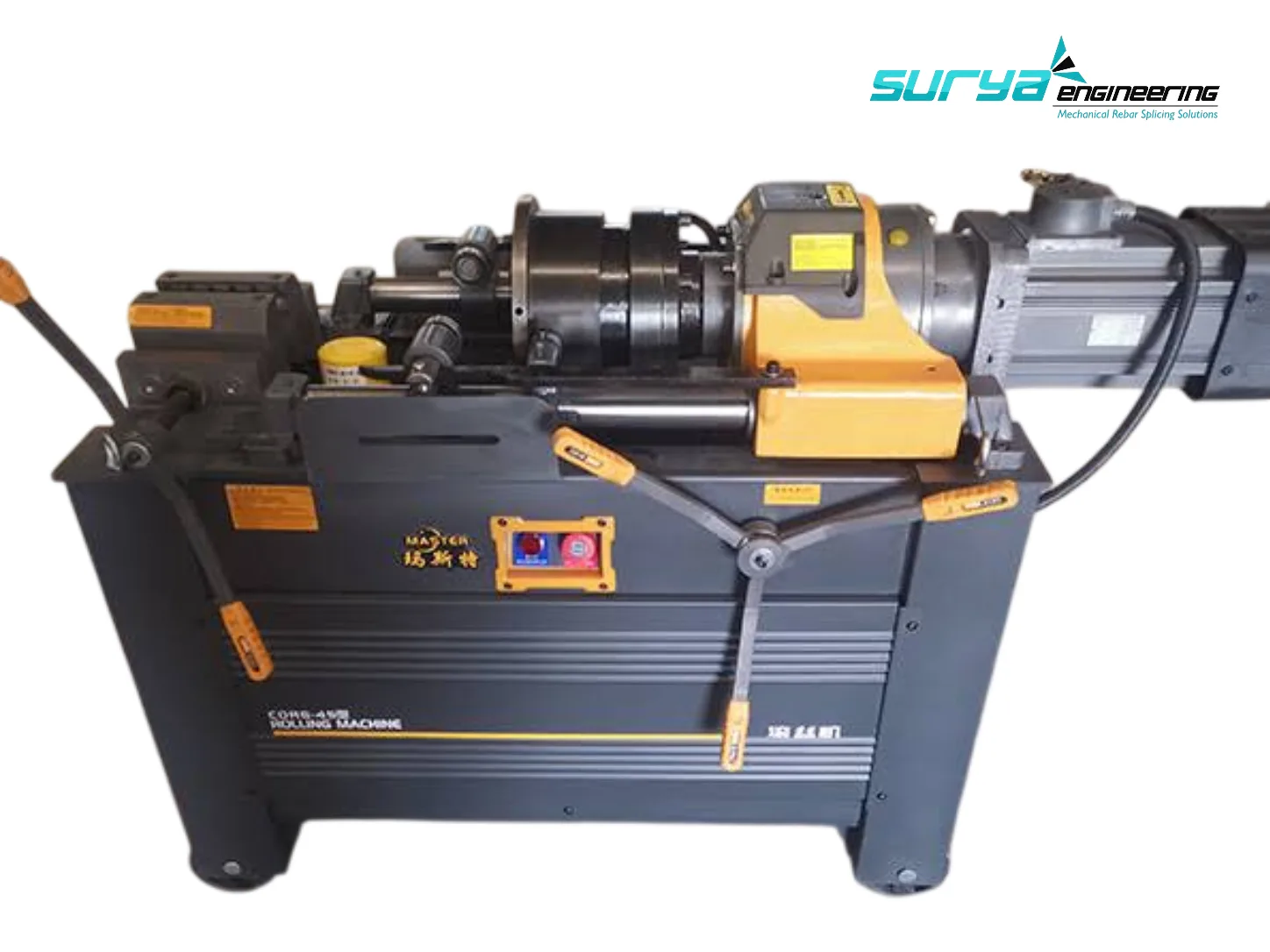
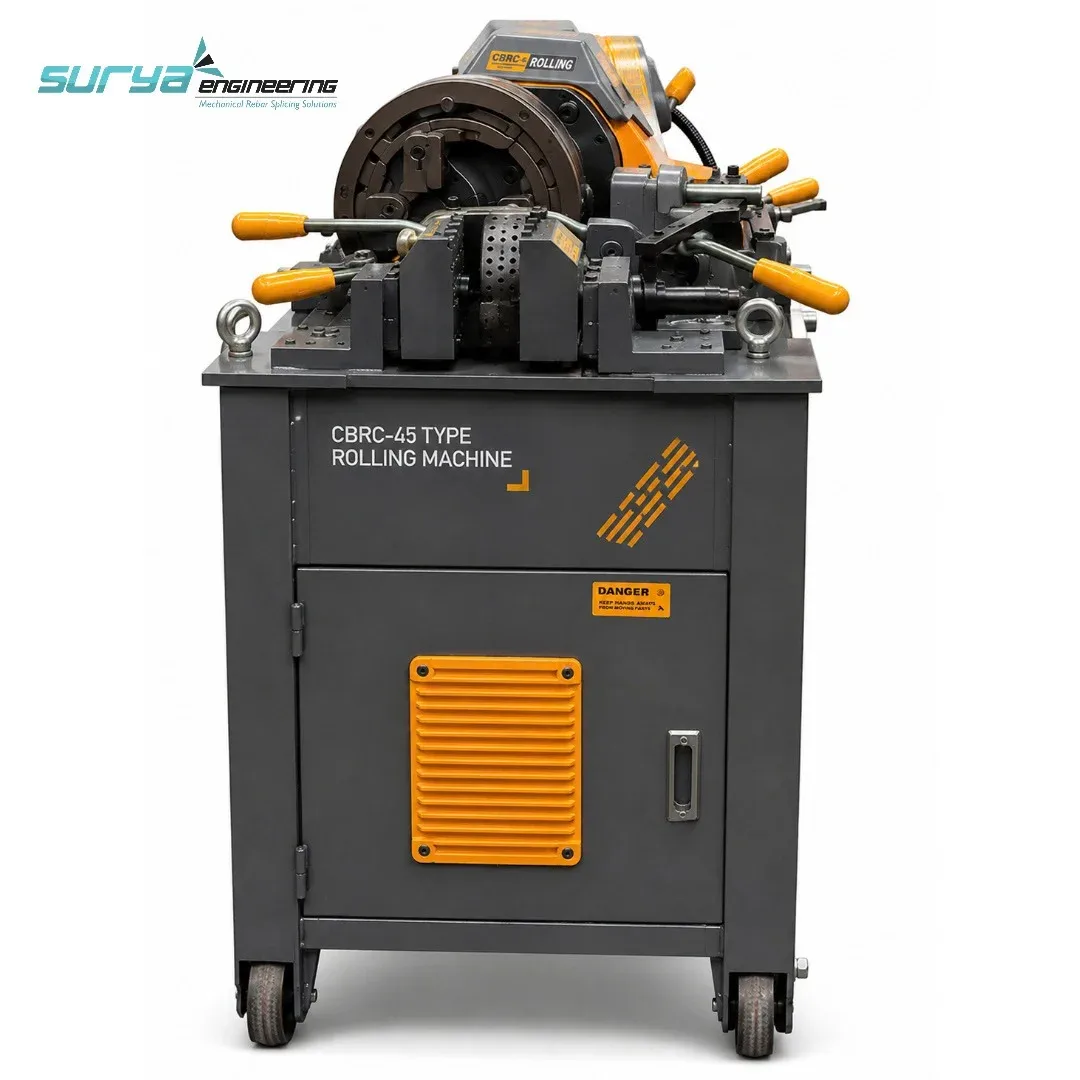
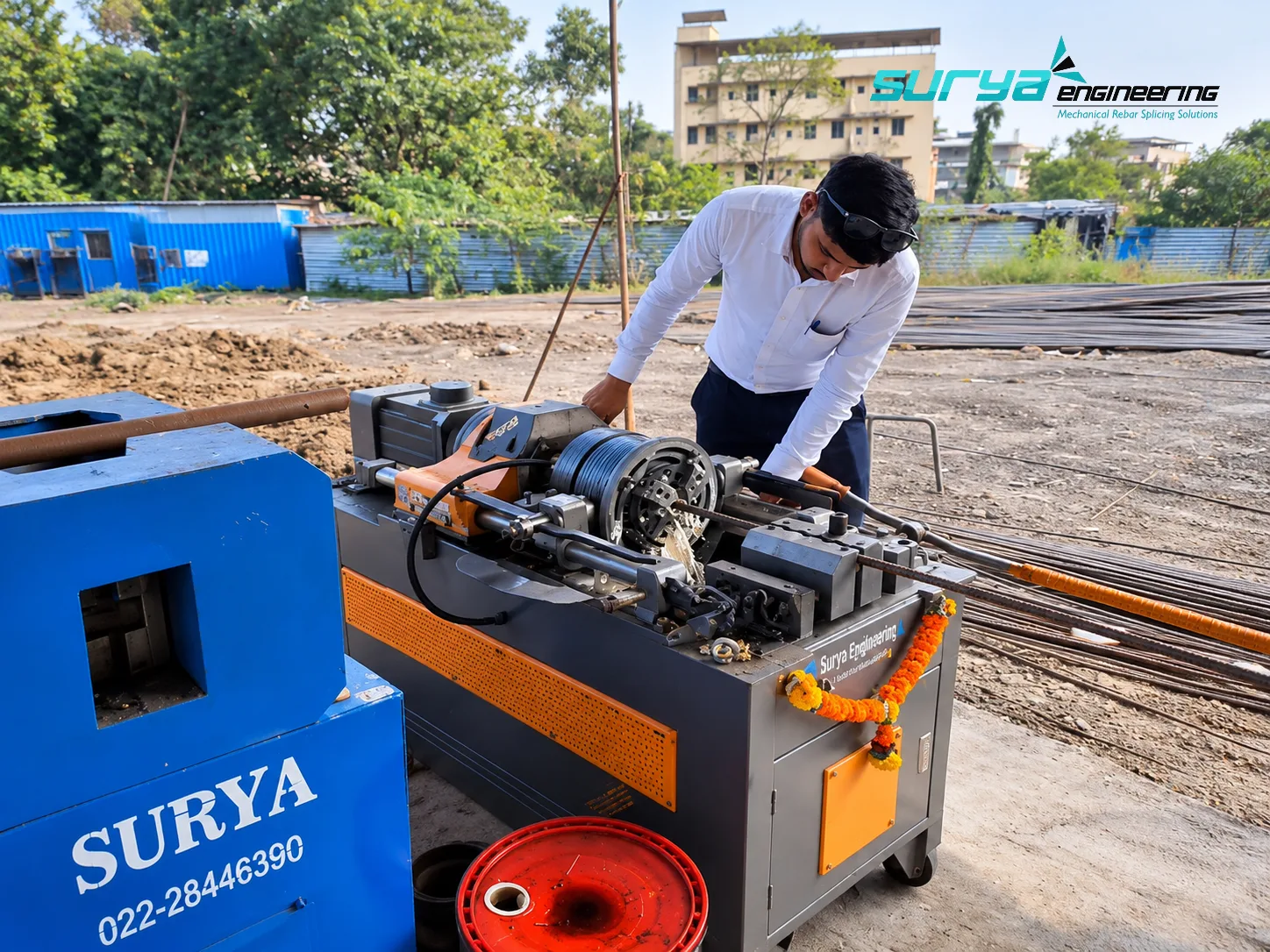
Roll threading machine for 16 mm to 40 mm rebar
CDRG-45 roll threading machine for 16 mm to 40 mm rebar. 5 HP motor, 40 to 62 rpm, 100 mm threading length, 380 kg.
Product Media
Look up the CDRG-45 online and you'll find some listings giving it a threading capacity of up to 50 mm. Our brochure gives the rated figure. The CDRG-45 rebar threading machine processes bars from 16 mm to 40 mm, and nothing outside that range.
Surya Engineering, a rebar threading machine manufacturer in Mumbai, supplies it as a roll threading machine. It forms the thread on the bar end so a mechanical coupler can join one bar to the next, rather than cutting the thread away. Contractors and fabrication yards use that joint where laps would crowd the reinforcement.
Rolling forms the thread by pressing it into the bar end rather than cutting it. Whichever method forms the thread, IS 16172:2023 asks designers to consider the effect of reduced bar diameter at the threaded end. That question belongs to the coupler system as a whole, so ask your coupler supplier for the test reports that cover your bar grade and size.
Annex G of the standard sets the minimum process for threading bars at site, and the machine is one step in it.
Bar ends come first. They must be saw cut or square cut, because disc cutting and gas cutting are banned. The CDRG-45 then forms the thread, and the checks follow.
GO and NO GO gauges check the major diameter of parallel threads, and a bar that fails has its thread cut off and goes back through the process. Every threaded end then takes a proof load of at least 80 percent of the bar's minimum specified yield strength, on a rig that punches its own mark on passing bars.
Plastic caps protect the finished threads until the bars are joined. The joined splice has to reach at least 130 percent of the bar's specified yield strength, or fail in the bar outside the splice length.
The standard also tests a threaded coupler with 15 percent of the total thread length, split evenly between the two sides, sitting outside the coupler. The splice must still pass. That margin only exists when every bar end carries the same thread length, so gauge the first bars of every new batch before a full run.
Our brochure lists a second roll threading machine, the SE-50. It covers the same 16 mm to 40 mm range and the same 2.5 or 3.0 pitch. It has a 7.5 HP motor running at 62 to 80 rpm, a threading length of 120 mm and a weight of 450 kg. The difference shows up in motor power, speed, thread length and weight, so choose by what your coupler drawing and your yard need.
Threading adds work. A review of mechanical splices in STRUCTURE magazine notes that it needs skilled operators and extra machines, and that couplers can cost enough to cancel the saving over laps. It also says cover shrinks at the splice because couplers are wider than the bar, so detail for that. Bare threaded ends need protection from corrosion, which the caps provide.
Buy the gauge set with the machine, and share your site supply with us before you order.
Surya Engineering provides technical assistance for machine installation, threading machine setup and rebar coupler system training. Customers can receive support through on-site visits or phone and video assistance. The warranty duration and coverage for the CDRG-45 should be confirmed with Surya Engineering at the time of purchase and specified in the quotation.
The Surya Engineering CDRG-45 Rebar Threading Machine is designed to process TMT reinforcement bars ranging from 16 mm to 40 mm in diameter. It features a 5 HP motor, a working speed of 40–62 RPM and a maximum threading length of 100 mm. It is suitable for preparing threaded bar ends for mechanical rebar coupler connections.
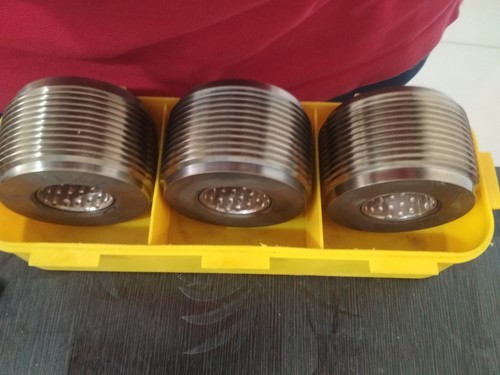
The CDRG-45 supports two standard thread pitch options: 2.5 mm and 3.0 mm. The appropriate pitch depends on the rebar diameter and the internal thread specifications of the mechanical coupler. Buyers should share their coupler drawing or thread specifications with Surya Engineering before selecting the threading rollers to ensure proper compatibility.
The CDRG-45 is designed for producing parallel rolled threads for mechanical rebar coupler connections. It can be used with compatible parallel-thread coupler systems, including standard, positional, reducer and transition couplers, subject to matching thread specifications.
Surya Engineering offers parallel rebar roll-thread couplers in sizes including 16 mm, 20 mm, 25 mm, 32 mm and 40 mm. The thread pitch, diameter and length must match the coupler design. For 40 mm connections, confirm the roller configuration separately because the published coupler specification lists a 3.5 mm pitch, whereas the CDRG-45 page lists 2.5 mm and 3.0 mm pitches.
Not for every application. It depends on the mechanical rebar coupler system being used.
For direct parallel-thread connections, the required bar-end preparation can proceed to threading without a separate upsetting operation. However, an upset parallel-thread system requires a cold forging machine to enlarge the TMT bar end before threading.
Surya Engineering also manufactures separate hydraulic cold forging machines: SE-32 for 16–32 mm bars and SE-40 for 16–40 mm bars. These machines prepare enlarged bar ends for subsequent threading where the coupler design requires it.
Not 12 mm bars, because the rated range starts at 16 mm. For 12 mm and 14 mm bars, ask about our TMT rebar threading machine, which covers 12 mm to 40 mm.
The one on your coupler drawing. The thread on the bar has to match the coupler, and the standard leaves thread details to the coupler maker's design.
Your bar sizes, the pitch and thread length from your coupler drawing, your site supply and how many bar ends you thread a day.
If your coupler drawing asks for a thread longer than 100 mm, go straight to the SE-50, which lists 120 mm.
Technical Details
Where It's Used
We manufacture to order. Contact our team with your requirements and we'll provide a tailored quote.
Customer Reviews
No reviews yet — be the first to share your experience with this product.
Explore similar engineering products from Surya Engineering.